I watched a GovTech firm waste many hours on a federal solicitation. They were technically disqualified before they hit submit. Effort wasn’t the issue. They lacked a filter. Implementing a formal RFP go no-go decision framework catches that disqualification in the first few minutes. Lean teams that skip this step lose the capacity to win the contracts that actually matter.
Why is the 40-hour RFP your most expensive sales activity?
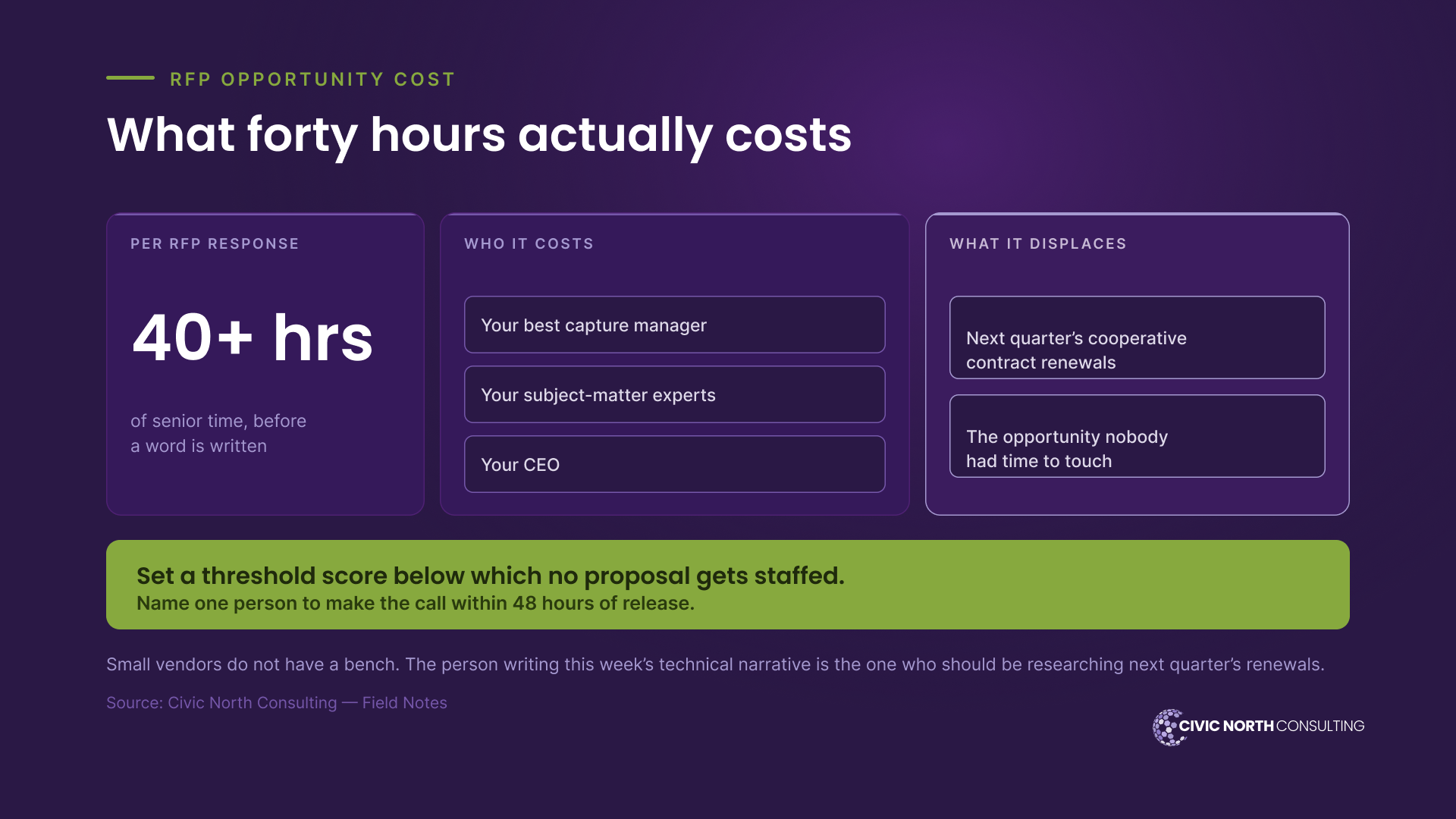
A full RFP response isn’t forty hours of writing. It’s forty hours of your best capture manager, your subject matter experts, and your CEO. They’re pulled off pipeline work to build a narrative for a solicitation you’ve got a low win probability for. High failure rates in this sector stem from a lack of proposal infrastructure rather than technical capability. The proposal fails in the resourcing decision made weeks before anyone ran the numbers. This specific type of RFP opportunity cost compounds every time you skip the filter.
The hidden cost of narrative fatigue
Small vendors don’t have a bench. The person writing your technical narrative this week should also research next quarter’s cooperative contract renewals. Every non-responsive bid you chase is a real opportunity sitting untouched. To prevent waste on low-value work, teams should use a discovery workshop framework. It helps validate ROI before they start. Refining your public sector procurement strategy requires saying no to the wrong bids early.
How do you use an RFP go no-go decision framework to score opportunities?
A compliance matrix isn’t optional paperwork. It’s the mechanism that turns gut feeling into government proposal scoring you can defend internally. Professionalizing your proposal documentation is critical for these scoring cycles. Score every opportunity against:
- Technical alignment: your product meets the requirements without a workaround
- Capability gaps: what you’d need to subcontract or build before submission
- Past performance: you have a directly comparable reference the evaluator can verify
- Incumbent advantage: a sitting vendor has a structural edge on price-to-win
Run this bid decision matrix before assigning a single hour of writing time.
How does the cooperative contract filter work?
Cooperative purchasing organizations run a rigorous process before any vendor becomes an awarded contractor. Supplier requirements (Sourcewell) make clear that scoring against specific criteria determines who gets on the vehicle. Relationship building alone isn’t enough. You must position proof of past success to satisfy these evaluators.
These programs typically use a lead agency model (Sourcewell). A single public entity runs the formal solicitation on behalf of every member. Evaluation stays centralized and consistent across thousands of participating agencies. That centralization is why a quantitative go/no-go matters. The evaluator scoring your response has done this hundreds of times and isn’t grading effort. Even in an automated environment, narrative clarity remains a primary advantage during this review.
What is on your readiness sprint checklist?
Pull your last five solicitation responses and score them retroactively against a four-point compliance matrix. If your team is still deciding case by case, it’s time to formalize your filter.
Paul Meehl reviewed twenty studies comparing expert judgment against simple scoring formulas and found the formulas won in every one. His 1954 book closes on the objection every expert raises, and his answer to it:
“Why should we care whether you think this one is different?”
Paul Meehl - Clinical versus Statistical Prediction, 1954
His point was not that experts know nothing. It was that the moment you let “this one is different” override the score, you have swapped a rule whose hit rate you can measure for an intuition whose hit rate you cannot. He later said no controversy in social science had produced such a large body of diverse studies coming out so uniformly in one direction.
That is the argument for a hard threshold rather than a strong preference. A threshold you override when an opportunity feels compelling is not a threshold. It is a record of the decision you were going to make anyway.
Set a hard score threshold. Do not staff any proposal below it. Assign one person to run the go or no-go call. Hold the call within 48 hours of release. Run a five-minute bid scorecard on every new solicitation before assigning writing hours.
Ready to win more of the contracts you bid? Schedule a consultation to review your proposal process and find where your bids are losing points.