A rural housing nonprofit we worked with had two staff members splitting grant duties with everything else on their plate. They applied to many opportunities each year and won only a few. The problem was not effort. Nobody mapped the funding environment before the writing began.
This is the pattern across rural nonprofit funding. Limited staff treat each solicitation as worth pursuing. As a result, they spend writing time on programs they cannot win. The fix isn’t more applications. It’s a pipeline built on funder navigation guidance. It tells you where to look before you start typing.
Why does rural nonprofit funding require a district-specific map?
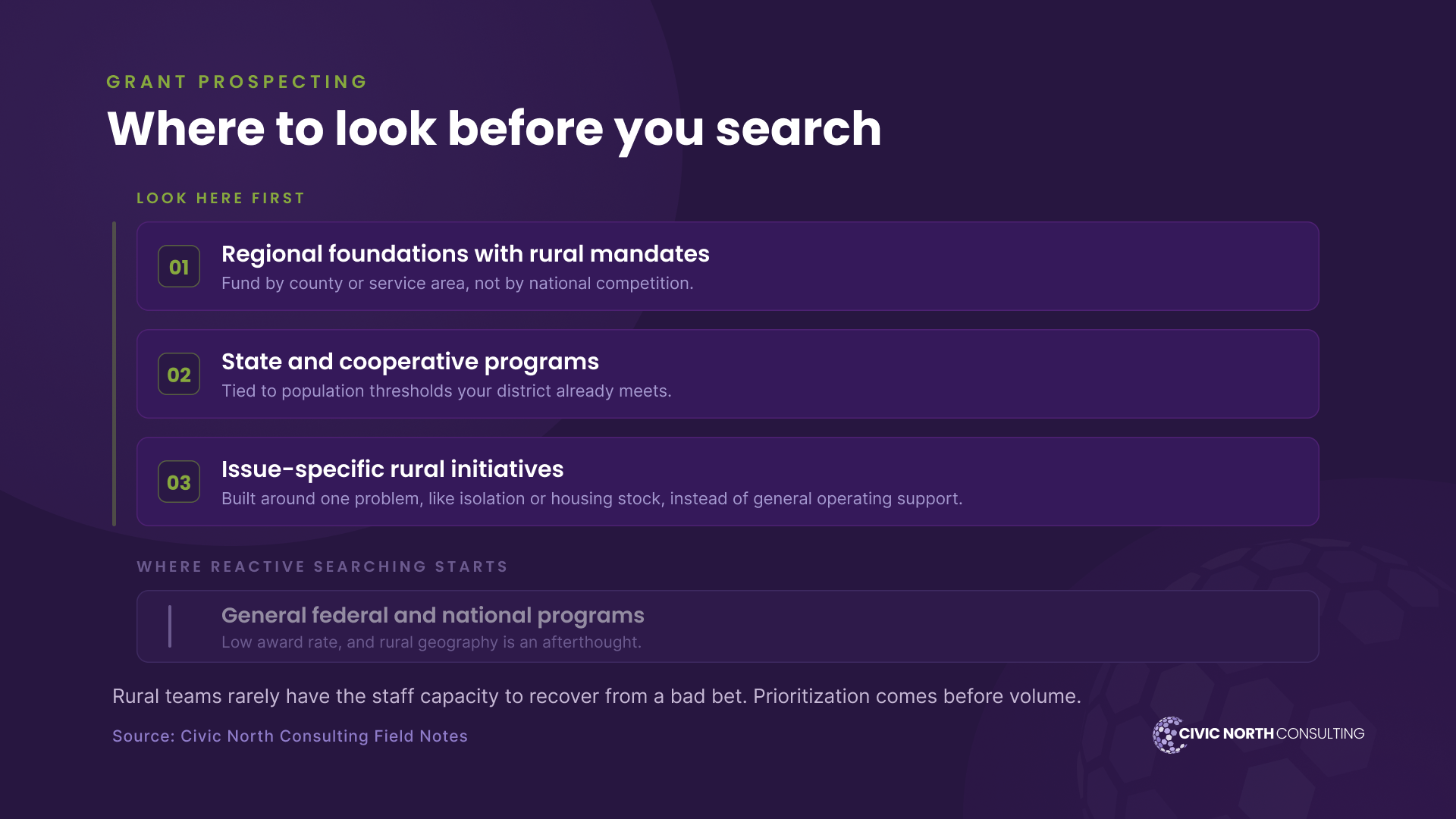
Reactive searching costs more than it looks like it costs. Every hour spent chasing a federal program with a low award rate is an hour not spent. It could go to a cooperative or regional grant. Your district already fits that eligibility profile. Rural organizations rarely have the staff capacity to recover from a bad bet. The first fix is prioritization, not volume.
Grant prospecting for a rural district starts with knowing which funders truly focus on rural areas. Three types are worth prioritizing first:
- Regional foundations with rural mandates that fund by county or service area rather than national competition
- State and cooperative programs tied to population thresholds your district already meets
- Issue-specific rural initiatives built around a single problem, like isolation or housing stock, instead of general operating support.
What is the technical baseline for SAM.gov and the UEI transition?
Unique Entity ID requirements
As of April 2022, every federal grant touchpoint runs through the Unique Entity ID, a 12-character alphanumeric identifier assigned by SAM.gov that replaced the old DUNS number for all federal grant registration, search, and data entry (USDA). According to USDA, organizations that let their SAM.gov registration lapse are locked out when a rural-specific solicitation opens.
Maintaining nonprofit grant readiness means renewing your SAM.gov registration before it expires, not after you spot a deadline. The USDA guidance notes that validation delays have affected organizations registering late. Treat this as standing infrastructure, not a task you do once a funder asks for it.
How do you find grants for nonprofits using cooperative models?
Cooperative purchasing vehicles exist to reduce the administrative burden on public entities. Nonprofits serving public functions can often access the same data these systems generate. According to NASPO ValuePoint, NASPO ValuePoint manages over $21 billion in annual spend across all 50 states. It uses a lead-state model to negotiate terms individual organizations couldn’t get alone.
Here’s how to use this for your own grant budgeting:
- Identify whether your state participates in a relevant ValuePoint portfolio for services your program needs
- Pull the negotiated pricing to build a realistic cost basis for your grant budget narrative
- Reference the cooperative vehicle in your budget justification instead of estimating vendor costs from scratch
A cooperative contract vehicle meets the competitive bidding requirement for the covered goods or services. It does not replace your grant application. It removes a procurement step that would otherwise take staff time.
How should you map your funder navigation guidance?
The Rural Voice initiative, led by the Initiative Foundation and supported by Sourcewell, gave $35,000 to nine projects. It funded projects in two Minnesota counties. According to the Initiative Foundation, it funded projects like an art therapy space for youth. It also funded senior programs to help reduce isolation. None of those projects started with a generic search. They started with town hall conversations. These talks told the funder and the applicants exactly where the need sat.
Elinor Ostrom won the Nobel in economics for establishing this point across decades of fieldwork on how communities actually manage shared resources:
“There is no reason to believe that bureaucrats and politicians… are better at solving problems than the people on the spot.”
Elinor Ostrom
Her finding was not that central institutions are incompetent. It was that they lack information the people on the ground already hold, and have no cheap way to acquire it. A program officer in St Paul cannot see which two blocks of your county have no transport to the clinic. A room of local residents can, in an afternoon.
That is why the Rural Voice conversations worked in both directions. They told the applicants what to apply for, and they told the funder what was worth funding. A general grant database gives you neither. It lists what exists, which is the one thing about your district that is already written down somewhere.
That’s the model worth copying. Mental health and social isolation funding in rural areas often goes to groups that name a clear local need. It goes less often to groups that only list many programs. Before you write a word, know which funder categories exist in your geography. Find out which ones have already funded something like your project.
If your organization still applies by volume, not by fit, use a structured scorecard for evaluating opportunities. It filters better than another search in a general database. Beyond improving your selection process, audit your SAM.gov registration today. Confirm your UEI is active before the next rural solicitation drops.
ot sure whether a solicitation is worth pursuing? Book a diagnostic call to see where your team stands before the deadline clock starts. Thirty minutes, no deck.