A rural nonprofit I worked with had a strong program and a committed board. However, their SAM.gov registration expired shortly before a federal deadline. The story was ready, but the systems were not. That gap keeps many rural organizations from major awards.
Nonprofit grant readiness is not a feeling. It is a measurable state based on your financial systems, governance documents, and compliance history. You must check these against what a specific funder requires before you submit anything.
How do you establish nonprofit grant readiness for federal awards?
A grant fit score measures how well a specific opportunity matches your mission, capacity, and strategic goals (FundRobin). Instead of chasing every open solicitation, you score each one against fixed criteria. That score tells you whether to invest the next forty hours or walk away. For growing organizations, moving from reactive applications to a planned grant capture process reduces staff fatigue and compliance risk.
Scoring mission and strategic alignment
- Program match: does the funder’s priority area match a program you already run, not one you would build to chase the money
- Geographic eligibility: does the funder explicitly serve rural or underserved regions
- Timeline fit: can you deliver the proposed outcomes inside the award period
- Past funder relationship: have you received funding from this agency or a similar one before
Internal capacity evaluation
Then score internal capacity against the award’s actual requirements. Do not rely on your optimism. A $500,000 federal award needs financial systems that can track and report at that scale. A small board without a finance committee often cannot handle the administrative workload. This can happen even if the project is very good. For technical projects, ensure your infrastructure grant writing ranks project specs against the funder’s program criteria. If your project involves community development, remember that housing grant writing follows the same rigorous documentation standards. For technical projects, ensure your infrastructure narrative ranks project specs against the funder’s program criteria.
What are the five pillars of administrative readiness?
Funders don’t judge your mission statement when they assess readiness. They judge five pillars: governance, financial systems, staff capacity, past performance, and compliance infrastructure. Two of these deserve a closer look because they stop more rural applicants than anything else. Securing sustainable rural nonprofit funding requires that these pillars be documented long before the RFP is released.
Registration and compliance standards
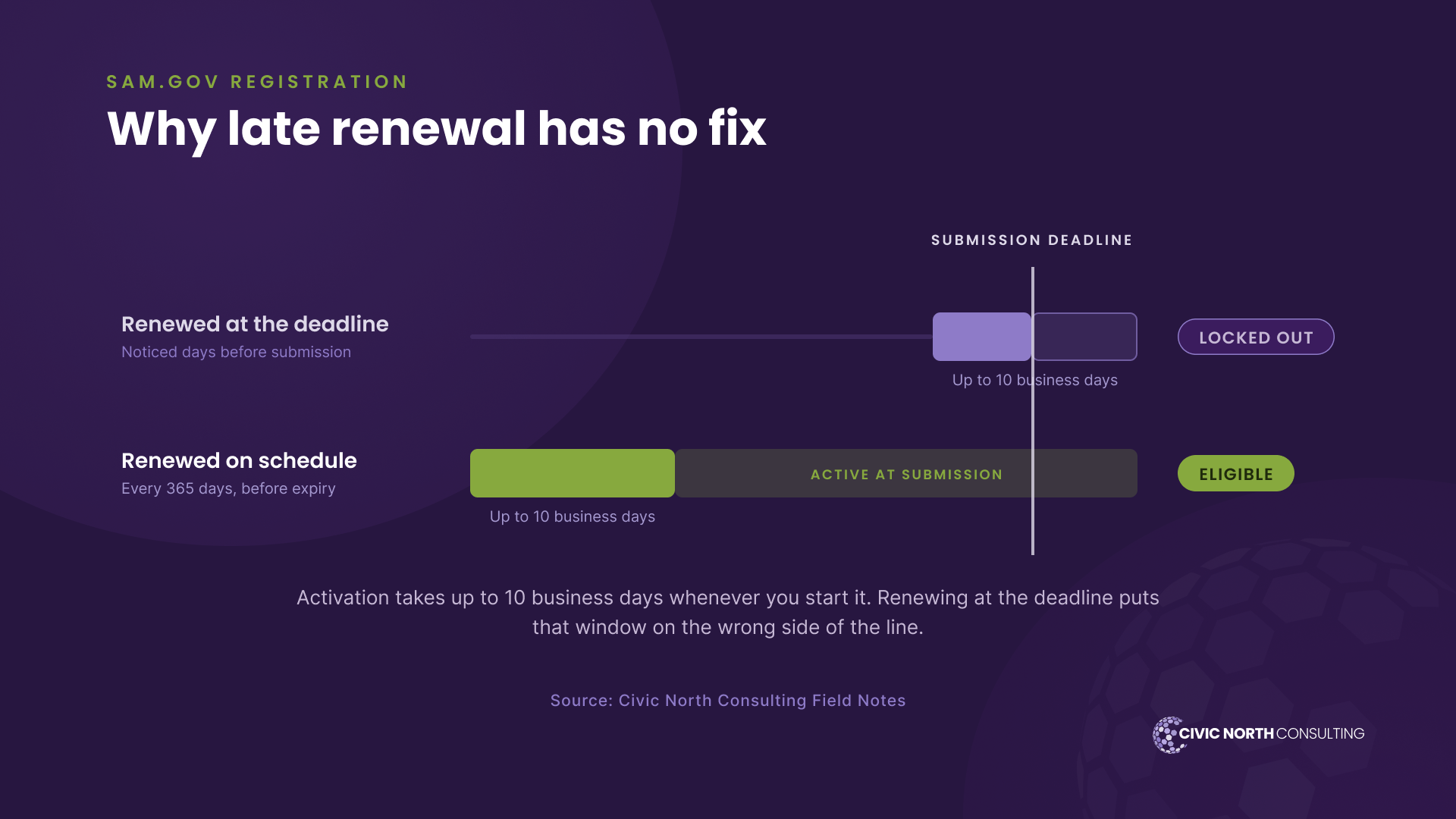
SAM.gov and federal registration. Registration may take up to 10 business days to activate. You must renew it every 365 days to stay eligible for federal awards (SAM.gov). Some registration steps require notarized documents under the Paperwork Reduction Act. Organizations that let this lapse find out at the worst possible moment, often just days before a deadline when there’s no fix.
2 CFR Part 200 compliance. This is the government-wide framework establishing administrative requirements, cost principles, and audit requirements for all federal awards (EPA). Updates became effective October 1, 2024. A funder reading your proposal checks if your internal controls can work in this framework. They are not just checking if your project narrative is interesting.
When should you pause for the go/no-go threshold?
Organizations expending $1,000,000 or more in federal funds in a fiscal year must undergo a Single Audit. That threshold rose from $750,000 under the 2024 Uniform Guidance revision. It applies to fiscal years that start on or after October 1, 2024. It is codified at 2 CFR 200.501. It is a useful diagnostic line rather than just a compliance trigger.
Wesley Cohen and Daniel Levinthal named the underlying constraint in 1990. What determines whether an organization can use an external resource, they argued, is:
“…the ability to recognize the value of new, external information, assimilate it, and apply it.”
Cohen and Levinthal — “Absorptive Capacity,” Administrative Science Quarterly, 1990
Their central finding was that this ability is largely a function of prior related capability. An organization cannot absorb a resource it has no existing structure to receive. Capacity is not something the award builds for you. It is the precondition for the award being usable at all.
A $500,000 federal grant is external information in their sense. It arrives with reporting obligations, cost principles and internal control expectations attached. An organization without a finance committee is not unambitious. It lacks the structure needed to absorb the award. Winning it would expose that gap rather than close it.
Using automated financial reporting can help maintain the timestamped records needed to protect an organization during these audits.
Go/no-go checklist
- Check whether your financial systems and board oversight could survive a Single Audit today, not after the award lands
- Confirm you can highlight past clean audits and documented internal controls in your capacity section. Funders look for this explicitly
- If either answer is no, the verdict is no-go: pause the application and build the infrastructure first
A bid scorecard built on the same go/no-go logic applies directly here. It works even though it was built for procurement bids rather than grants. Implementing a quantitative go/no-go framework prevents resource waste on low-probability bids and protects leadership capacity. Investing in capacity building for nonprofits now helps the team avoid feeling overwhelmed by post-award reporting requirements.
What are the steps in your readiness sprint?
- Pull your last two financial audits and confirm they are clean, or identify the specific findings that need resolution
- Check your SAM.gov registration status today, not next week
- Run your top three target grants through a fit score against mission, capacity, and timeline
- Review your readiness checklist against your board’s current oversight structure
- If you score below the threshold on two or more pillars, delay your application. Schedule a capacity-building quarter instead
Stop hiring a grant writer for an organization that isn’t ready to manage what it might win. Build the procurement-grade infrastructure first. When the right solicitation shows up, submitting it should be a formality instead of a scramble. Using an objective go/no-go framework ensures you focus only on opportunities with a high probability of success.
Discover our flexible engagement models. Choose focused diagnostic sprints or full proposal development. Get ongoing pipeline management at Civic North Consulting.