A vendor finishes a successful pilot and gets positive feedback from the agency. The agency then says the vendor must join a full solicitation process. The technical proof was accepted. The procurement path was never prepared. Congratulations on the pilot, and welcome to the beginning.
That gap creates pilot purgatory. A practical GovTech procurement strategy closes it by moving the conversation from product validation to procurement readiness. This shift is essential when public sector sales scaling depends on local jurisdictions. Scaling requires a move from technical proof to procurement-ready positioning to avoid failing at the conversion stage.
Why do pilots fail to scale in fragmented markets?
The cost of local solicitations
Each jurisdiction may have its own calendar, solicitation format, and evaluator expectations. They also have their own contract terms and compliance requirements. Repeating that work for every agency can take too much commercial attention. You need that time to develop the product and support existing users.
Cooperative purchasing agreements address part of this administrative burden. Agencies can access pre-competed contracts instead of issuing a redundant solicitation for every purchase (Sourcewell, cooperative purchasing). Moving from siloed hardware to unified solutions often means building an integrated data chain. This data chain supports the broader vehicles they are designed around. Scaling the commercial side has its own mechanics. Lessons from scaling agile GTM teams in adjacent regulated verticals transfer more than most GovTech founders expect.
Technical proof vs procurement readiness
Teams treat a successful pilot as the final proof point. It is usually the point where capture work has to get serious. A pilot answers one technical question: can this work here? A procurement decision asks a different set. Is the vendor responsive? Does the contract vehicle permit the purchase? Can the evaluator verify pricing, security, implementation, and past performance from the documents in front of them?
Everett Rogers spent a career on why technically sound things fail to spread. His finding was that adoption turns on attributes perceived by the adopter rather than on merit, and the one that matters here is compatibility:
“…the degree to which an innovation is perceived as consistent with the existing values, past experiences, and needs of potential adopters.”
Everett Rogers — Diffusion of Innovations
Rogers found that five perceived attributes explain somewhere between 49 and 87 percent of the variance in how fast something gets adopted. Technical superiority is only one of them, and it is not the binding constraint in public sector sales.
A procurement system is the existing practice your product has to be compatible with. The pilot tested relative advantage and trialability, which are two of the five. It tested nothing about whether your evidence fits the form an evaluator has to complete. That is the gap, and it is a compatibility problem rather than a product problem.
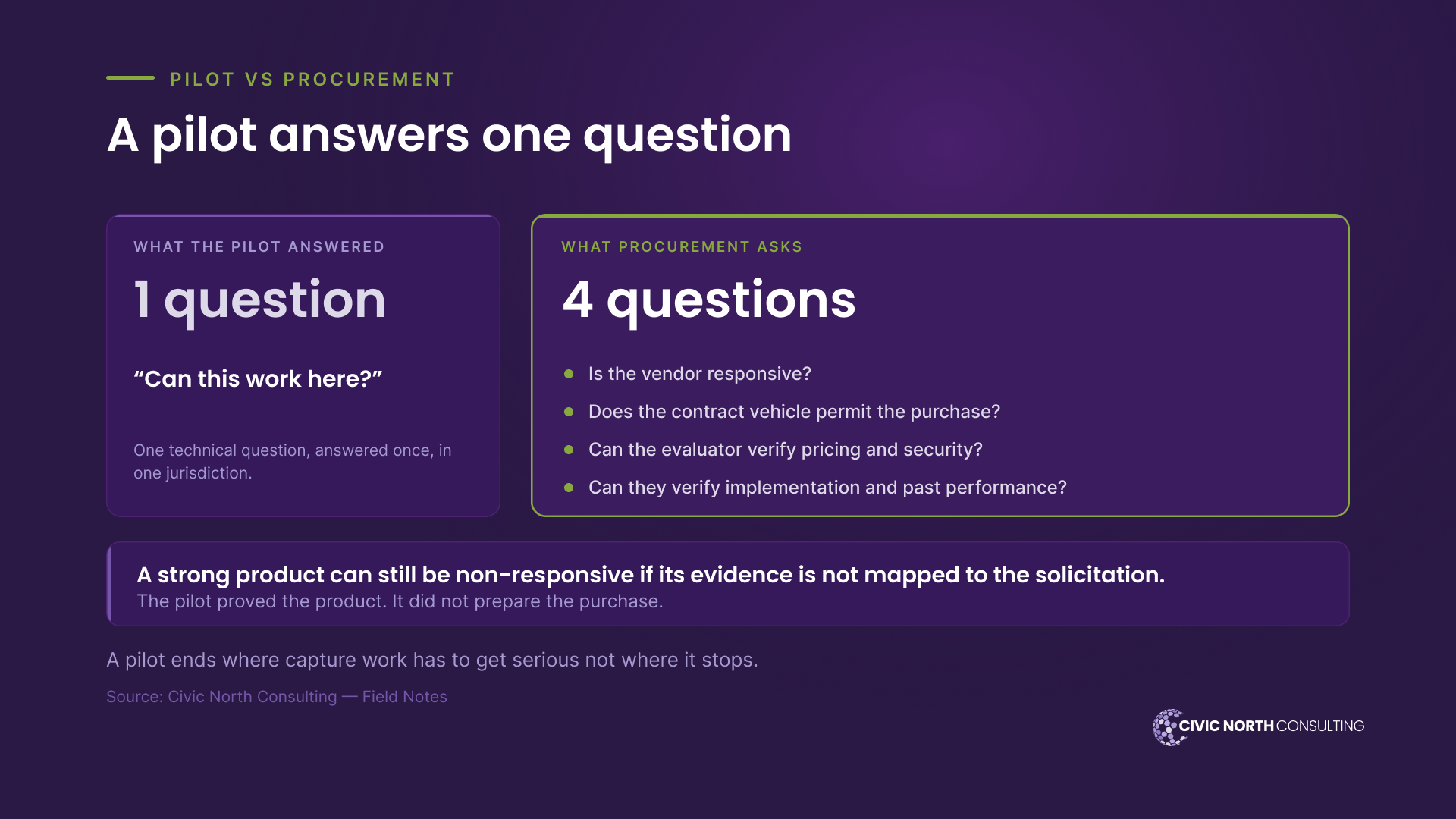
A strong product can still become non-responsive if its evidence isn’t mapped to the solicitation. Even high-value opportunities can be derailed by unprofessional proposal documentation that fails to meet agency standards. A proposal compliance matrix makes that gap visible before the next opportunity arrives.
How can vendors reach agencies without a new solicitation each time?
Procurement mechanism overview
| Step | Description |
|---|---|
| Lead-agency solicitation | A public entity runs the original competitive process and establishes the contract terms. |
| Eligibility review | The buying agency confirms that it can use the contract under its laws, policies, and membership requirements. |
| Scope alignment | The solution, services, pricing structure, and delivery model must fit the awarded contract. |
| Purchase documentation | The vendor supplies the materials needed for evaluation, ordering, implementation, and compliance review. |
Piggybacking means an eligible agency uses the terms of a contract. The lead agency competitively solicited the contract. This use must follow applicable rules and the agency’s procurement authority. The lead agency runs the competitive bid process for all participating members. This meets the formal competition requirement for everyone (NASPO ValuePoint buyer FAQs). Nothing here removes the competition. It has already happened, once, and you can sell against it rather than repeating it in every jurisdiction. Long buying cycles reward patience. The stages and metrics that actually matter across one are worth mapping before you chase the next pilot.
The contract helps you avoid repeating the same market-entry steps in each jurisdiction. It guides you into a defined purchasing route. That is the whole prize.
Are there specialized marketplaces for emerging technology?
The infrastructure for emerging technology is beginning to reflect how agencies actually buy. New cooperative purchasing marketplaces for AI solutions give vendors a procurement-oriented channel built around shared access (GlobeNewswire). What they offer is a route that is already compliant, not an exemption from compliance.
A GovTech company scaling into this market needs a route that matches the buying process. Product maturity alone doesn’t create a contract vehicle.
What are the three steps to become procurement-ready?
- Map the pilot evidence. Connect outcomes, security materials, implementation details, and references to the evaluation requirements a public buyer will review. Get past success and customer impact documented before the formal cycle begins.
- Identify contract paths. Review cooperative purchasing agreements and find lead agencies or marketplaces whose scope fits the solution and target jurisdictions. Do this during the pilot, not after it.
- Build repeatable capture materials. Maintain an up-to-date compliance matrix, capability narrative, pricing documentation, and response library. This helps each opportunity start from an approved base.
Start by identifying one lead agency or cooperative contract in your target sector. Then test whether your pilot evidence supports that purchasing path before pursuing another standalone solicitation.
If you want to know if your pilot evidence would pass a public buyer’s review, our calendar is open.