We watched a rural nonprofit pull a promising request before breakfast. By noon, they realized they could not prove compliance. Not because the work was weak. Because nobody owned the attachment list.
A database finds the opportunity. It will not manage the compliance matrix or the technical evaluation that follows. If your funding comes from public-sector contracts, grant writers must balance mission storytelling and procurement rules. Most services only do one.
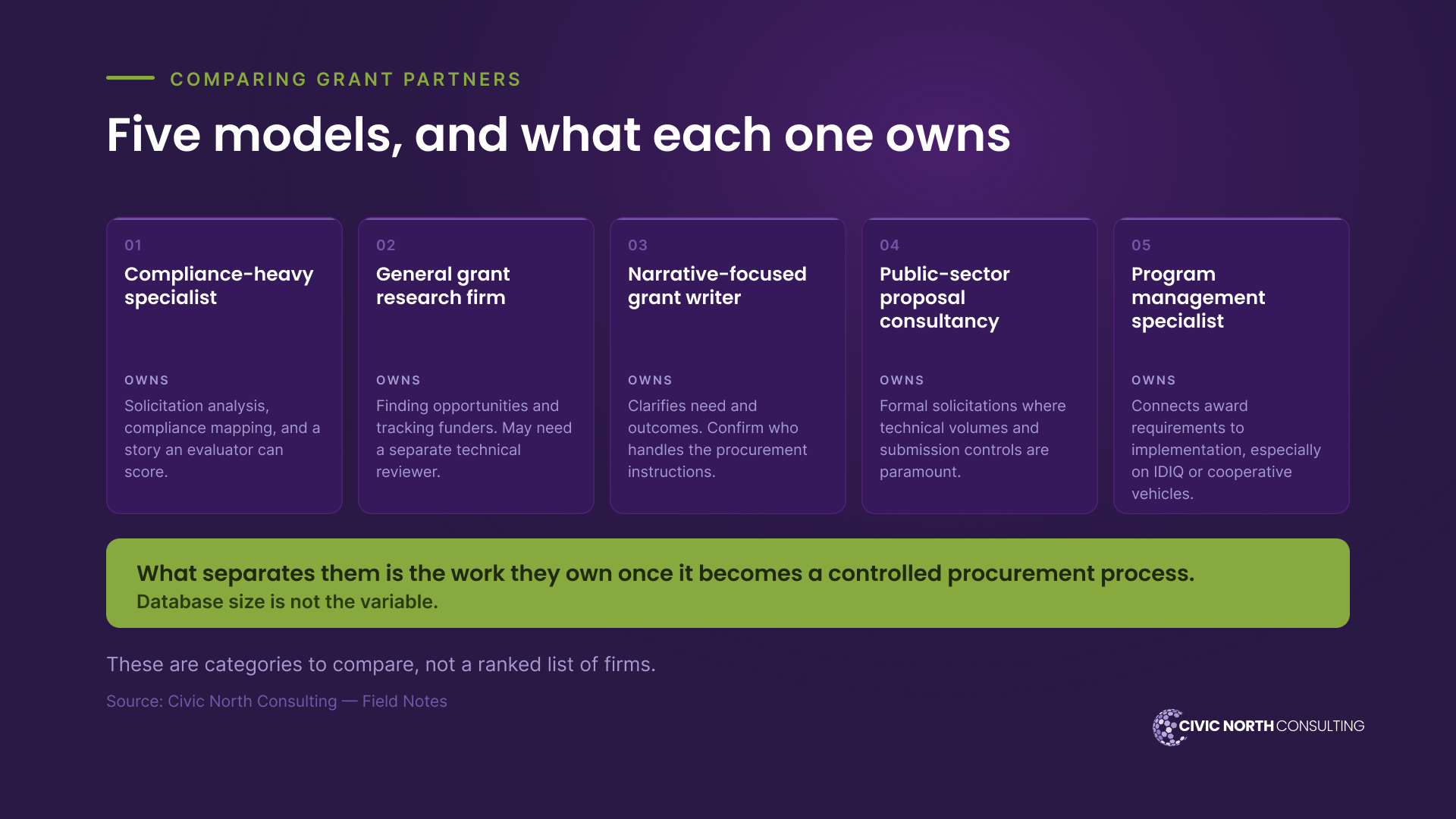
There are five models worth comparing. These are categories, not a ranked list of named firms. One category is our own. We include it for transparency, not to put ourselves first.
Why are databases failing the modern nonprofit?
Where data stops and execution starts
Grant databases are useful for early qualification. They help a small team sort opportunities by agency and deadline. But they don’t interpret a solicitation’s instructions or assign owners to evidence requirements. They can’t test whether a response is complete before you hit submit.
Russell Ackoff made this argument about information systems generally in 1967, in a paper he pointedly titled “Management Misinformation Systems.” Most such systems, he wrote, are built on the assumption that the critical deficiency is a lack of relevant information:
“…they suffer more from an overabundance of irrelevant information.”
Russell Ackoff — “Management Misinformation Systems,” 1967
His point was that adding information to an organisation already drowning in it does not improve decisions. It just moves more of the work onto the person who has to separate what matters from what does not.
A grant database is a textbook case. It increases the volume of opportunities arriving in front of a three-person team without touching the thing that actually determines the outcome: who owns which requirement, and whether the evidence behind it exists. That gap is the reason the week disappears and the decision does not.
That is where the exhaustion comes from. Staff spend their week moving information between tools. The real decision stays unresolved: is this submission even responsive? A non-responsive submission fails before anyone reviews the writing. The writing is often what the team is most proud of. The teams that avoid this get their readiness sorted early, articulating what they actually do before anyone starts drafting.
The hidden cost of do-it-yourself compliance
Improving nonprofit grant readiness comes down to review discipline. Grant writing education covers the basics well. A complex procurement vehicle needs someone who can link each requirement to a delivery plan. It also needs someone who understands what the evaluator is scoring.
The test is short. Can your team say which requirement each section answers? Does someone own the evidence behind it? If the answer is no, the database did its job and the process let you down.
Funders are increasingly using AI to screen grant proposals, making technical precision non-negotiable. A practical test is simple. Can the team explain which requirement each section answers? Do they know who owns the evidence? If not, the database did its job, but the proposal process did not account for algorithmic gatekeepers. These now stand between a submission and a human reviewer.
How do we align grant writing services with procurement goals?
Procurement vehicle impact
Cooperative purchasing contracts give eligible organizations a way to access pre-vetted options. Sourcewell reports more than 50,000 participating public agencies across its cooperative contracts (Sourcewell). That scale matters because a rural organization often has far less procurement capacity and the same accountability.
IDIQ program management
IDIQ program management also changes the work after an opportunity is identified. Common IDIQ contracts simplify project delivery and reduce overhead during bidding. The consultancy has to understand the vehicle, the solicitation, and the handoff into delivery. Automated drafting is everywhere now, which only raises the value of a narrative a human evaluator can actually follow.
Which five consultancy profiles are worth comparing?
What separates grant writing services is the work they own once an opportunity becomes a controlled procurement process. Database size is not the variable.
- Compliance-heavy specialist. This firm bridges the gap between procurement-grade review and narrative. The model fits teams that need solicitation analysis, compliance mapping, and a story an evaluator can score.
- General grant research firm. This category is useful for finding opportunities and tracking funders. It works well for early qualification, though you may need a separate technical reviewer for complex responses.
- Narrative-focused grant writer. This specialist clarifies need and outcomes by applying effective fundraising techniques. The nonprofit should confirm who handles procurement instructions.
- Public-sector proposal consultancy. This category fits organizations responding to formal solicitations where technical volumes and submission controls are paramount.
- Program management specialist. This partner connects award requirements to implementation. That connection matters when the proposal is tied to an IDIQ or cooperative vehicle.
How can you audit proposal readiness?
Select one upcoming solicitation and build a requirement-to-evidence matrix. Separate your responsiveness checks from the technical evaluation. Responsiveness is a compliance determination. Technical evaluation is a points-scored ranking.
If you want a read on where your last submission actually lost points, our calendar is open. No pitch, just an honest look at where you stand.