A rural nonprofit can spend four days preparing an application. It can lose eligibility if one field is handled wrong. The portal receives the submission. It does not create the opportunity, and it will not tell you that you have already lost.
For executive directors and development officers, funder navigation means moving from watching the portal to managing the relationship. The portal is the technical floor. Everything that decides the outcome happens above it, usually months earlier.
Chester Barnard described this distinction in 1938, writing as a working executive rather than an academic. Alongside the formal organisation of rules and procedures, he identified an informal one:
“…the aggregate of personal contacts and interactions.”
Chester Barnard — The Functions of the Executive, 1938
His argument was that the two are interdependent, and that the informal organisation is what carries communication and cohesion the formal structure cannot. Neglecting it, he thought, was how organisations failed.
A procurement portal is formal organisation in its purest form: identical fields, identical rules, no memory and no judgment. Everything Barnard meant by informal organization sits outside it. This includes the program officer who knows which service gap keeps returning. It also includes the procurement staffer who can name the buying route before it limits you. Learning an organisation, as he put it, is chiefly learning who is who and why is why. None of that is in the form, which is precisely why the form cannot tell you that you have already lost.
How can teams move from reactive to prepared submissions?
Online systems make every applicant use the same fields and submission rules. But they don’t make every applicant equally prepared. Organizations that understand the agency’s operational problem, evaluation priorities, and procurement route can write to those conditions before a solicitation is published. A standardized data field cannot explain why the work matters. That is where human-centered storytelling fills the gap the form cannot.
Developing a long-term public sector procurement strategy aligns internal resources with expected government needs. Yet even a compliant response can miss the real requirement. APMP and Shipley practices prioritize capture, customer knowledge, and compliance planning well before final production. Neglecting this basic proposal infrastructure is a key reason many submissions fail. They often fail before reaching the evaluator’s desk.
Portal fatigue sets in when every open notice gets treated as its own emergency. Staff chase the latest form and confirm attachments against a deadline, and the compliance matrix becomes something you meant to do. Meanwhile, responsiveness depends only on instructions published weeks ago. In those exact windows, inconsistent documentation prevents a strong application.
Managing the submission process
Record recurring requirements, identify decision-makers, and maintain reusable evidence before the next notice opens. It also helps to know that the first reader may not be a human, which changes how you prepare the technical side. This forms the foundation of nonprofit grant readiness and funder navigation guidance.
Can pre-competed contracts reduce procurement bottlenecks?
Cooperative purchasing organizations give eligible public buyers access to pre-competed contract pathways. Sourcewell describes these pathways as a way to reduce administrative burden through structured access to existing contracts (Sourcewell). Public buyers also use cooperative portfolios to improve efficiency across multiple jurisdictions (NASPO ValuePoint contract portfolios).
A cooperative contract doesn’t remove the need for fit, documentation, or agency approval. What it removes is the need to begin every procurement from scratch. Treat these vehicles as one part of a broader navigation strategy:
- Check eligibility: Confirm that the nonprofit, agency, or participating public buyer can use the relevant contract vehicle.
- Map the portfolio: Identify which contract categories match the service, technology, or infrastructure need.
- Prepare procurement evidence: Keep capability statements, references, and required forms current.
- Coordinate with the buyer: Clarify the intended purchasing route before a formal request creates avoidable constraints.
How do you build a go/no-go framework?
A practical RFP go/no-go framework tests fit before the team commits proposal hours. It preserves the distinction between responsiveness and technical evaluation. Responsiveness concerns compliance with instructions, while technical evaluation ranks the substance of competing offers. Funding cycles are long buying cycles. The stages and metrics that matter across a long cycle apply here more than most nonprofits expect.
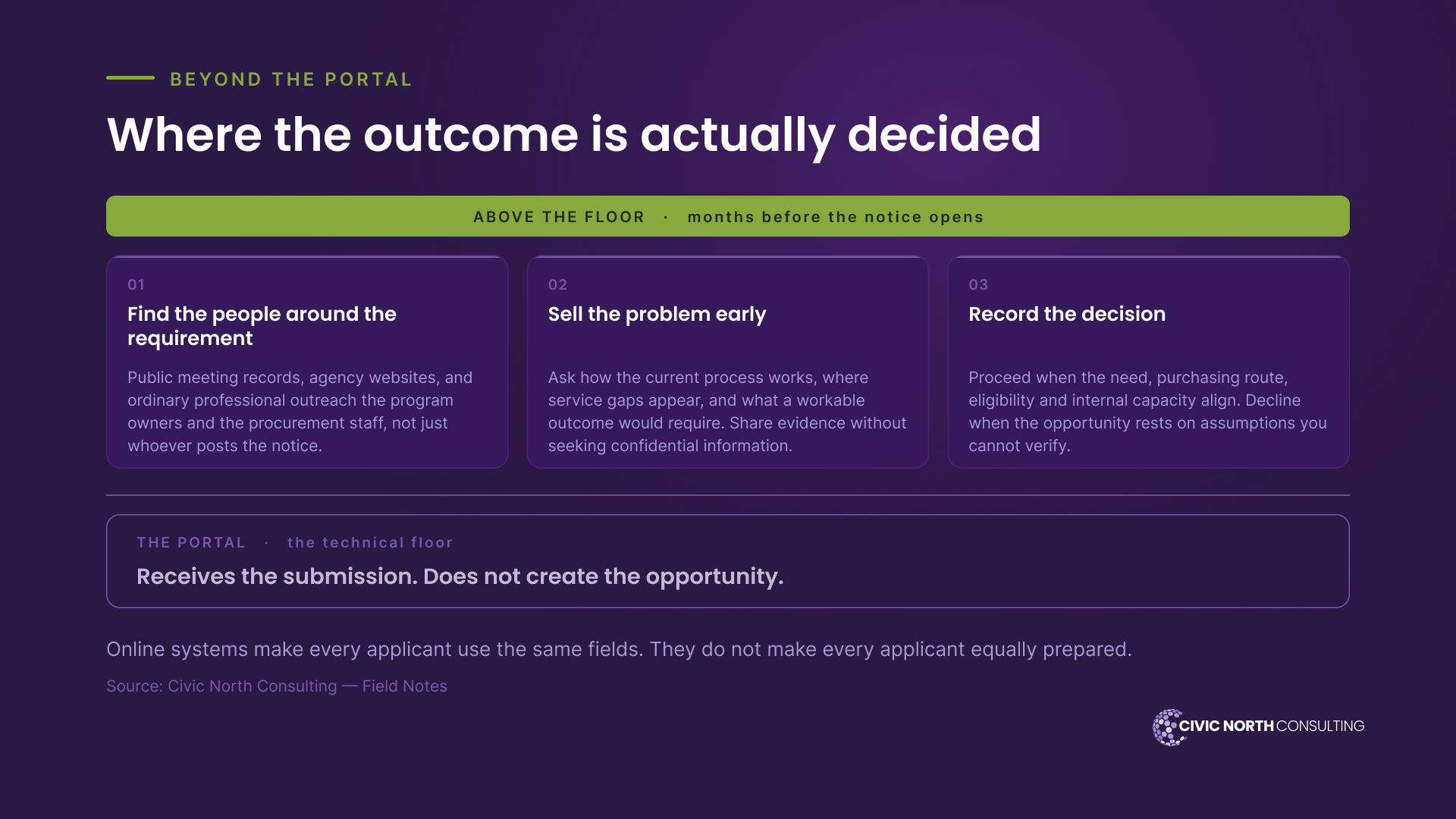
Identify the people around the requirement
Use public meeting records, agency websites, and ordinary professional outreach to find the program owners and the procurement staff. This is the unglamorous part, and it is where the win actually happens, long before the portal opens.
Sell the problem early
Ask how the current process works, where service gaps appear, and what a workable outcome would require. Influence future solicitation requirements by sharing education and evidence without seeking confidential information. Transparent value communication gives agencies useful context while preserving a fair solicitation process.
Record the decision
Proceed when the need, purchasing route, eligibility, and internal capacity align. Decline when the opportunity depends on assumptions the team can’t verify.
What are the next steps for strategic capture?
Start with one upcoming funding or procurement opportunity and apply these steps:
- Build a one-page compliance matrix from its published requirements.
- List the agency roles connected to the problem, not only the person who posts the notice.
- Schedule a factual discovery conversation to document what remains unknown.
A pre-solicitation plan is what puts you in a position to shape your own competitive footing. A readiness check on your current materials will show if they already communicate value. It will also show if you still need to do that work.
If this is your week and you want a read on where you actually stand, our calendar is open.