GovTech procurement strategy gets treated as a writing problem, but in my view, it’s usually a reading problem. A technically strong vendor can lose before the first draft. This happens when nobody qualifies the opportunity. It also happens when nobody maps the solicitation. It can also happen when nobody figures out how evaluators will score it. For anyone running a live pipeline, this is execution against a deadline, not creative writing.
The practical approach to winning public sector contracts is repeatable. Qualify the right opportunity and maintain strict compliance. You must communicate your value before anything else to ensure technical capability translates into evaluator evidence before drafting begins. Finally, submit exactly what the solicitation requires.
Establishing a GovTech procurement strategy for the response lifecycle
A usable proposal response framework moves through four connected stages. Each stage removes a different avoidable risk. This helps teams manage an active pipeline. It also avoids inefficiency from cyclical internal staffing.
Identification and qualification
Capture starts before drafting. Review the solicitation for agency need, contract vehicle, and scope. Check eligibility, timeline, evaluation factors, and submission instructions. Then make a disciplined Go or No-Go decision using win probability, delivery fit, competitive position, and response cost.
Qualification protects scarce subject-matter time. A No-Go decision keeps the pipeline from consuming resources that belong on a better-matched opportunity. Government funding cycles have long buying cycles. The stages and metrics that matter across one make the qualification call defensible. In public safety, that call increasingly means shifting from hardware sales toward integrated data environments.
Drafting and compliance shredding
Build a compliance matrix before assigning sections. Map every shall, page limit, and attachment to an owner and a verification point. Do the same for format rules and evaluation factors. Draft to the evaluator’s question rather than a preferred product narrative. Scope language is where this gets concrete. A worked example, like how to write a janitorial scope of work, shows how specific a public buyer’s needs can be.
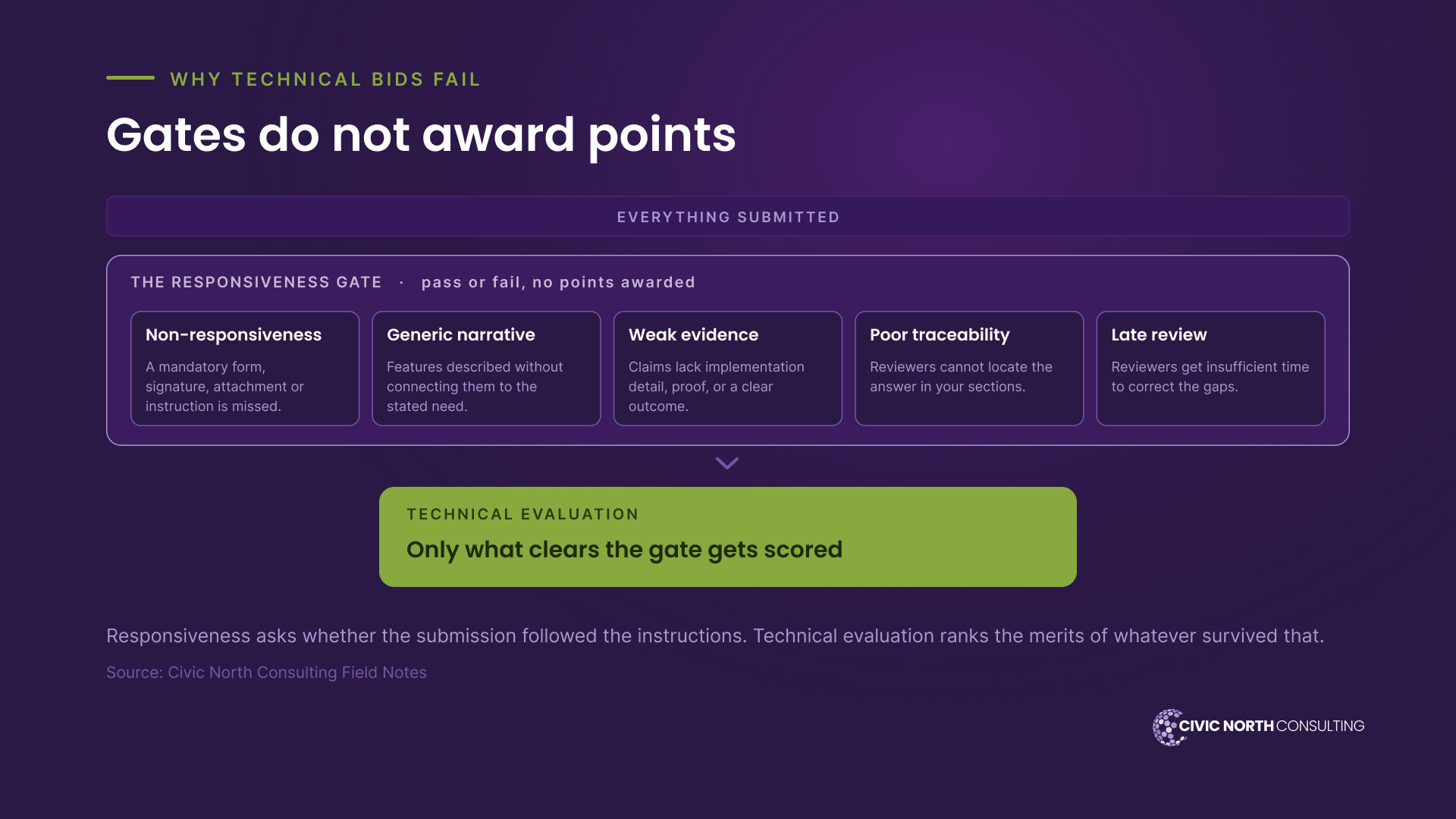
A compliance shredding review tests the response line by line. It checks responsiveness separately from technical evaluation. Responsiveness concerns whether the submission follows mandatory instructions. Technical evaluation ranks the merits of a compliant response.
Submission and post-award strategy
Submission is a controlled production event, which is a dry way of saying this is where good work goes to die. Confirm file names, signatures, forms, and permissions against the solicitation. Check attachments and delivery receipts. A strong response can become non-responsive over a missed marker, and one spreadsheet error nearly cost a $2M contract.
Post-award planning starts during capture. Connect promised capabilities to implementation assumptions, roles, and risks. Include measures that the delivery team can support. The narrative must survive the handoff.
Why technical bids fail the scoring rubric
Competitive solicitations require suppliers to satisfy specific evaluation criteria and survive a detailed scoring rubric. Sourcewell’s own supplier guidance sets out what that process asks of a vendor (Sourcewell, becoming a supplier). Common failure points include:
- Non-responsiveness: A mandatory form, signature, attachment, or instruction is missed.
- Generic narratives: The response describes features without connecting them to the agency’s stated need. Storytelling that reads as human is what makes an evaluator believe you understand the job.
- Weak evidence: Claims lack implementation detail, proof, or a clear outcome for the evaluator to assess.
- Poor traceability: Reviewers cannot locate the answer because section references and headings do not follow the solicitation.
- Late review: Compliance and technical reviewers receive insufficient time to correct gaps.
Technical merit only starts counting once the response clears the solicitation’s requirements. Everything before that is a gate, and gates do not award points.
Building a narrative around technical specifications
Start with the evaluator’s problem. State the operational condition and explain the proposed method. Show how the technical specification addresses it. Then identify the evidence that supports the claim. This is public sector proposal development as a chain of proof.
A strong narrative gives each requirement a job. It connects architecture to use, security controls to risk, implementation steps to adoption, and past performance to relevance. Plain language wins. Evaluators score answers, not prose.
Barbara Minto built a method on exactly that constraint. After two decades of corporate writing at McKinsey, she reduced structure to a single rule:
“Ideas in writing should always form a pyramid under a single thought.”
Barbara Minto — The Pyramid Principle, 1987
The single thought, in her formulation, is the answer to the reader’s question. Not the writer’s preferred opening, and not the background that led you to it. Her point about the structure is the one that matters for a proposal: a pyramid forces you to present information only as the reader needs it.
An evaluator’s question is already written down for you, in the evaluation factors. A response organised around your product’s architecture asks them to assemble the answer themselves, scoring as they go. A response organised around their question hands it over. Same technical content, different scores.
This is part of why so many RFP responses fail before anyone submits them.
Cooperative purchasing
Cooperative purchasing offers another route for agencies seeking pre-vetted contracts (Sourcewell, cooperative purchasing). It does not remove the need for positioning. Cooperative purchasing compliance still requires the vendor to understand the vehicle, the agency use case, and the applicable requirements.
Pipeline team next steps
- Create the matrix. Record every requirement, evaluator factor, owner, source, and review status for the next qualified solicitation.
- Run the readiness sprint. Test reusable content against current requirements, then assign technical and compliance reviewers before drafting begins.
- Set the decision gate. Approve a Go or No-Go using fit, evidence, capacity, and timing.
Winning government business is a process of qualification and disciplined storytelling. Build the matrix for your next opportunity, then make the decision before anyone starts writing.
If you want that decision pressure-tested before you commit the hours, our calendar is open.