We reviewed a bid from a GovTech firm that pursued a municipal contract for weeks, only to be disqualified on page one. The technical solution outperformed the incumbent’s, but the team missed a certification listed in the compliance matrix. It was flagged as non-responsive. For them this equated to weeks of work wasted. And the sad part was, the customer never got to read the good part.
That is what compliance-as-clerical-work costs.
Why does government contract compliance start before the solicitation?
Government contract compliance starts long before the solicitation hits your inbox. It begins with the decision to bid. You must identify which requirements are mandatory. You must produce procurement-grade evidence without rebuilding files for every new cycle. Positioning proof of past success is the main filter in this process. It lets teams judge their readiness before the clock starts.
Responsiveness is binary. A submission either follows the solicitation instructions or it doesn’t. Technical evaluation is different: that’s where evaluators score your approach against published criteria. Confusing the two is how teams end up polishing prose while an unanswered requirement sits in the file. A strong technical answer won’t fix a missing form, a late attachment, or an unanswered requirement.
Every new bid sends teams hunting for certifications and updating past performance content, confirming representations, mapping requirements to evidence. A reusable content library and a disciplined compliance matrix reduce repeated work. This is the proposal infrastructure most teams are missing.
What belongs in the evidence library?
Momentum comes from not rebuilding the same evidence every cycle. Most solicitation requests repeat, so fast teams keep them in one place with an owner. They also set a review date for each item.
- Representations and certifications. Insurance certificates, registrations, licenses, and small business or diversity certifications. Each document shows its expiration date clearly. The date is not buried in a PDF.
- Past performance. Write-ups tied to the kind of buyer and the kind of work, not a general capability statement. Each one needs a reference contact who knows they are listed.
- Key personnel. Resumes in the format solicitations actually ask for, kept current as people change roles.
- Technical and security documentation. Architecture, controls, implementation approach, and whatever your sector’s assessments require.
- Pricing structures. What you can defend, with the assumptions written down beside it.
The test of a library is not whether the documents exist. It is whether someone who did not build it can find the current version of any item in under a minute. Anything failing that test is a deadline waiting to happen.
Michael Polanyi identified the problem underneath that test. Opening The Tacit Dimension, he set out to reconsider human knowledge starting from one fact:
“…we can know more than we can tell.”
Michael Polanyi — The Tacit Dimension, 1966
His subject was skill that resists being written down. The version that matters here is more mundane and more expensive. The person who assembled your evidence library knows which insurance certificate is current, which past performance write-up was rewritten after the last debrief, and which reference has actually been warned they are listed. None of that is in the folder. It is in them.
That knowledge is invisible until the week they are on leave and a solicitation closes in four days. The one-minute test is simply a way of forcing the tacit into the explicit before a deadline does it for you.
What does strategic readiness look like internally?
Internal compliance workflows should let an executive answer four questions without a meeting: Which requirements recur? Who owns each response? What evidence supports it? When was that evidence last approved?
For companies bidding at scale, those answers should live in a controlled system. They should not sit in an inbox. They should not be stored in a spreadsheet, as one spreadsheet demonstrated at a cost of nearly $2M. A spreadsheet works until the moment you’re juggling multiple projects at once.
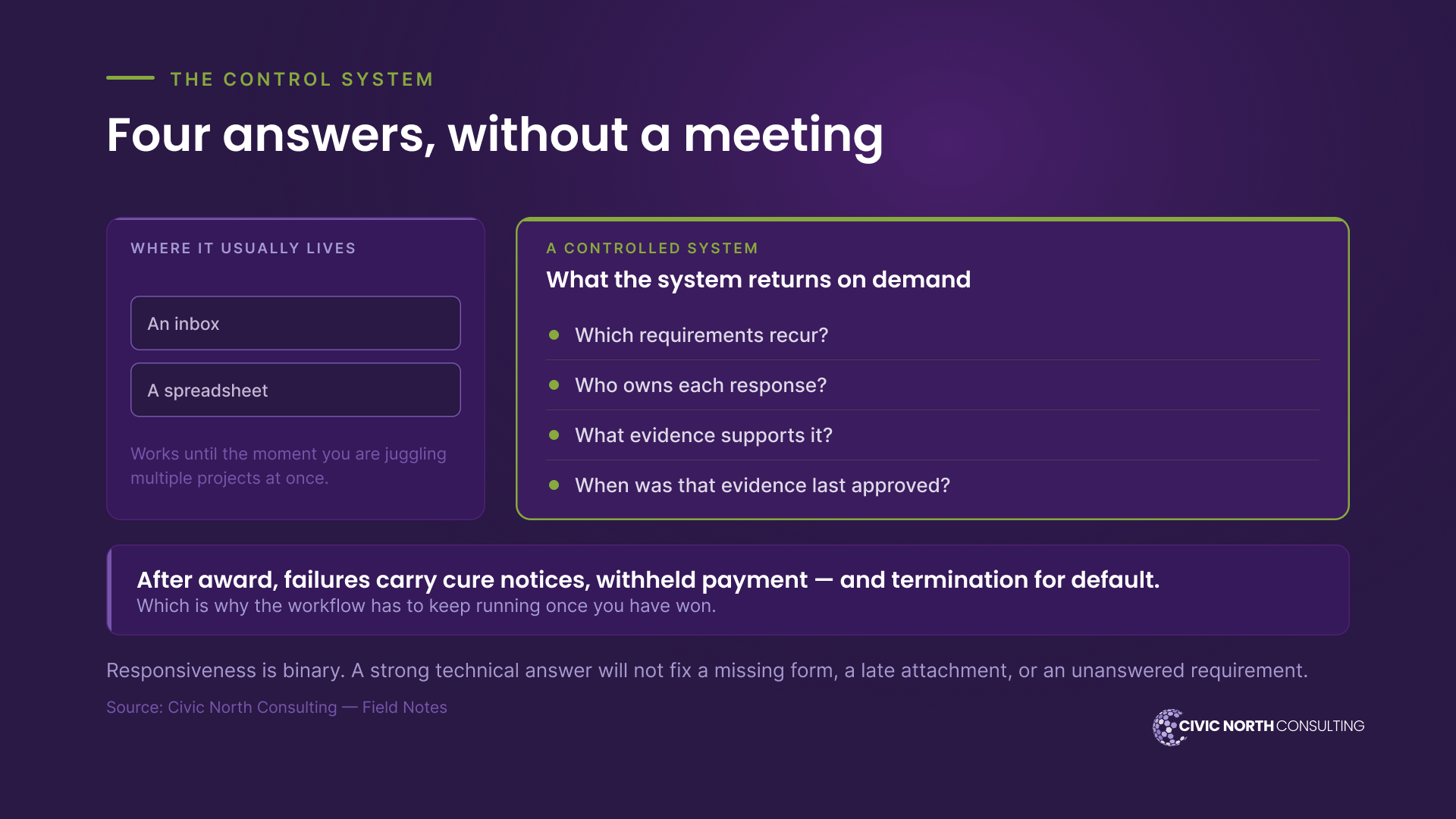
Automation can route requirements and flag missing evidence. It can also track approvals and maintain an audit trail. What it protects is the team’s time for strategy and agency conversations, while human judgment still makes the calls. Compliance failures after award have real consequences. These can include cure notices and withheld payments. In serious cases, they can lead to termination for default. That is why the workflow must keep running after you win. Moving compliance training online is one way teams keep that discipline current without adding headcount.
What should happen in a readiness sprint?
Readiness action items
- Map the pipeline. Separate active opportunities by type, purchasing vehicle, and deadline. Identify mandatory government contract compliance requirements.
- Build the control system. Create the compliance matrix and evidence library. Set ownership rules and review points for recurring needs.
- Test the handoff. Run one opportunity through the workflow. Fix any gaps before the next deadline reveals them.
If you want a second read on where your compliance workflow breaks under deadline, our calendar is open.