Grant readiness failures in rural nonprofits are usually administrative: a SAM.gov registration that lapsed before a federal deadline, an expired account on a state grants portal, or a board list or audit that a county program or community foundation asks for and nobody has updated. Each one can stop a strong program before a reviewer reads a word about it.
That holds whether the money comes from a federal agency, a state program, a county or city, or a community partnership, and each of those sources keeps its own records on you. Nonprofit grant readiness in 2026 means tracking all those records as one system. Do it on a schedule, so problems show up while there is still time to fix them.
Why is a manual grant readiness checklist failing rural nonprofits?
The static nature of PDF checklists. A checklist printed in January tells you nothing about your status in September. Registration status, entity records, and reporting obligations change. A PDF doesn’t; it gets filed in a drawer. Nobody opens it again until a funder asks for proof of eligibility. By then, the information is already wrong.
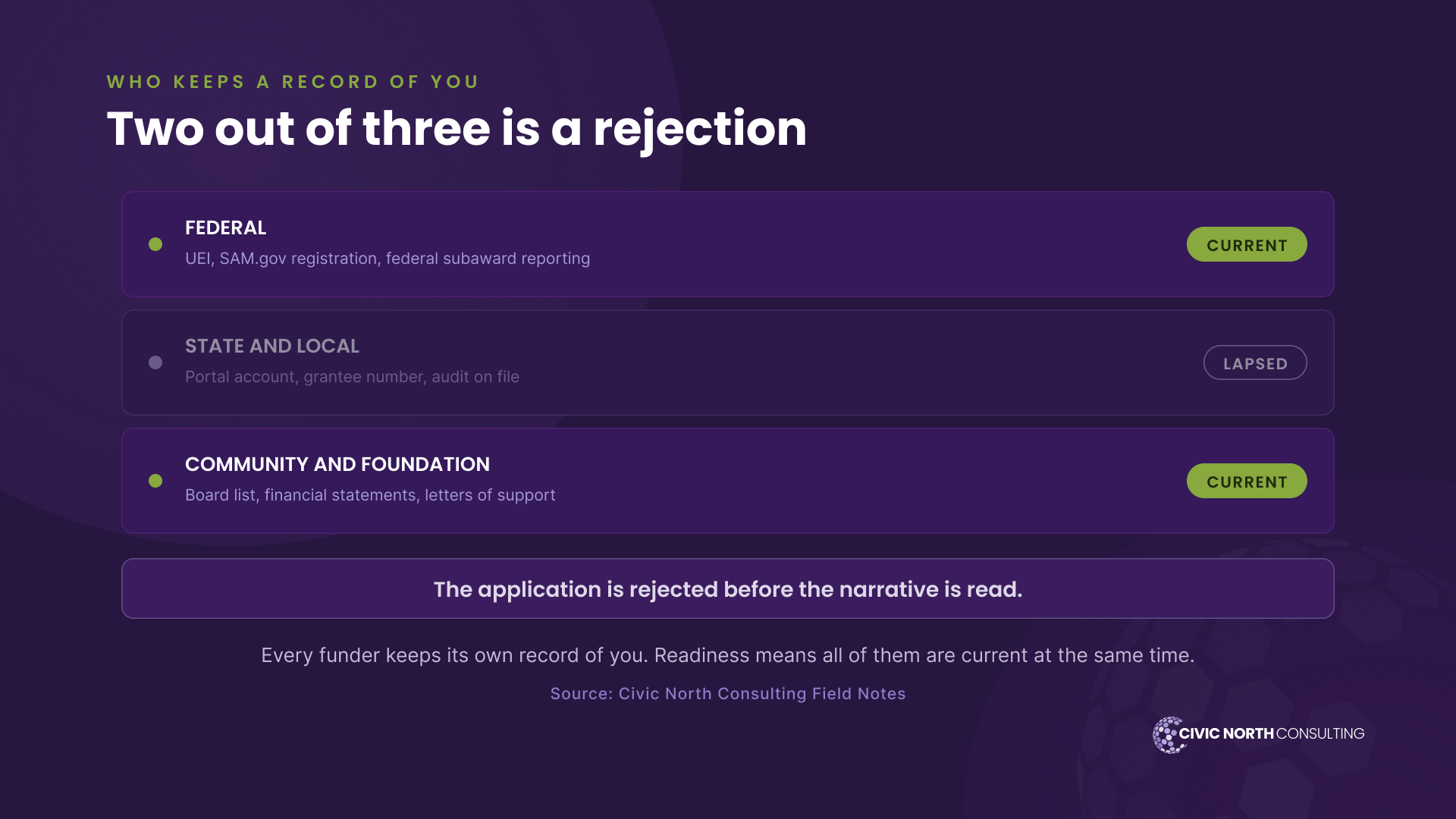
The cost of administrative lapses. An active SAM.gov registration is required to apply for and receive federal grants and to file subaward reports. State and local programs have similar requirements. These include a state grants portal registration. They may also require a grantee or vendor number. You may need current financial statements. An audit on file may also be required. A lapse in any of them can get an application rejected regardless of how strong the narrative is. For organizations managing multiple funding streams, proactive grant capture reduces the risk of these administrative fatigue points.
How does a digital diagnostic improve nonprofit grant readiness?
Every funder keeps its own record of you. A diagnostic tool should track the fields each one checks. It should do this automatically and on a schedule. It should not wait for someone to remember. For federal awards that means SAM.gov, which now runs the entire federal award lifecycle through a single portal. For state and local money it means the relevant portal, grantee number and document set. For community foundations and partnerships it usually means current financials and a board list. The principle is the same across all three. Screening is now often automated at the first pass. Knowing the first reader may not be a person is a good reason to keep records clean.
At minimum, that means monitoring:
- Unique Entity ID status, confirming it’s active and matches the organization’s legal name
- SAM.gov registration expiration, flagged well before the renewal window closes
- Assistance listing and program alignment. Confirm the organization qualifies for the specific federal listing, state program, or local fund it plans to pursue. Do not rely on the broader category
- State and local portal accounts confirm that your registrations, grantee numbers, and required documents are current. Check them with each state agency, county, or city program you apply to
- Partnership-ready records, keeping board lists, financial statements and letters of support current for community partnership opportunities
- Reporting obligations, including federal subaward reporting and any state or local progress reports that apply
Building strategic compliance infrastructure builds capacity for nonprofits in practical terms. It is a running check you can trust between funding cycles.
How do a Readiness Sprint and a self-assessment work together?
A Readiness Sprint is a consultant-led review of an organization’s compliance standing, run before a funding cycle begins. It sets the baseline. Keeping that baseline current between reviews is the job of a standing self-assessment. Ensuring you have a complete grant readiness checklist helps you spot bottlenecks before they cause a missed deadline.
A technology-enabled self-assessment is a standing check the organization runs itself, on its own timeline. The sequence matters: first, confirm entity and UEI status. Second, confirm assistance listing eligibility. Third, confirm reporting obligations are current. Each step catches a different failure mode. The sequence ends with a structured go/no-go evaluation. This helps save staff time for higher-probability applications.
For towns and counties, the same accuracy applies to municipal infrastructure grant applications. A rejected application can delay a project by a full funding cycle. Skipping one step just moves the failure later in the process rather than saving time.
What are the steps for your 3-step digital compliance audit?
- Pull your current SAM.gov status and each state or local portal account. Confirm each expiration date against your upcoming federal, state, and local application deadlines.
- Cross-check your eligibility with the specific program you plan to apply to. This may be a federal assistance listing, a state program, or a county fund. Do not rely on the broader category.
- Document reporting duties for each active funder, so reports and check-ins do not surprise you mid-cycle.
Rural nonprofit funding depends on infrastructure most organizations never see until it fails. A strong application needs proof of past results well before the deadline. A grant readiness evaluation is a good time to check your impact data and program stories. Run this audit before you write the next word of your next application.
If you want a read on where your readiness actually stands before the next cycle, our calendar is open.