Your SAM.gov registration renews once a year. Check it every month anyway, and check it before the writing starts rather than before the deadline. Representations and certifications change between renewals. Addresses change. NAICS codes drift out of line with the work you actually do. A registration that has quietly expired, or no longer matches your codes, can remove a strong bid before review starts. Catch that in week one of a pursuit and it is an afternoon of admin. Catch it the night before submission and it is the bid.
For pipeline safety and public safety infrastructure vendors, that monthly check is the cheapest compliance control available. Government contract compliance decides if an evaluator will read your narrative. So treat your registration, evidence library, and control systems as strategic infrastructure, not paperwork.
Why does government contract compliance start with your entity registration?
SAM.gov is the official source for federal contract opportunities, entity registration, and Unique Entity ID issuance. For infrastructure vendors chasing PHMSA or EPA-funded pipeline work, this registration is the baseline. Stale or incomplete entity data can delay a bid. It can also mean you never see the right set-asides or alerts.
Representations and certifications are where stale data hides, because nothing visibly breaks when they go out of date. They sit there looking fine until a reviewer checks them against your actual scope.
How does a NAICS code mismatch hurt a bid?
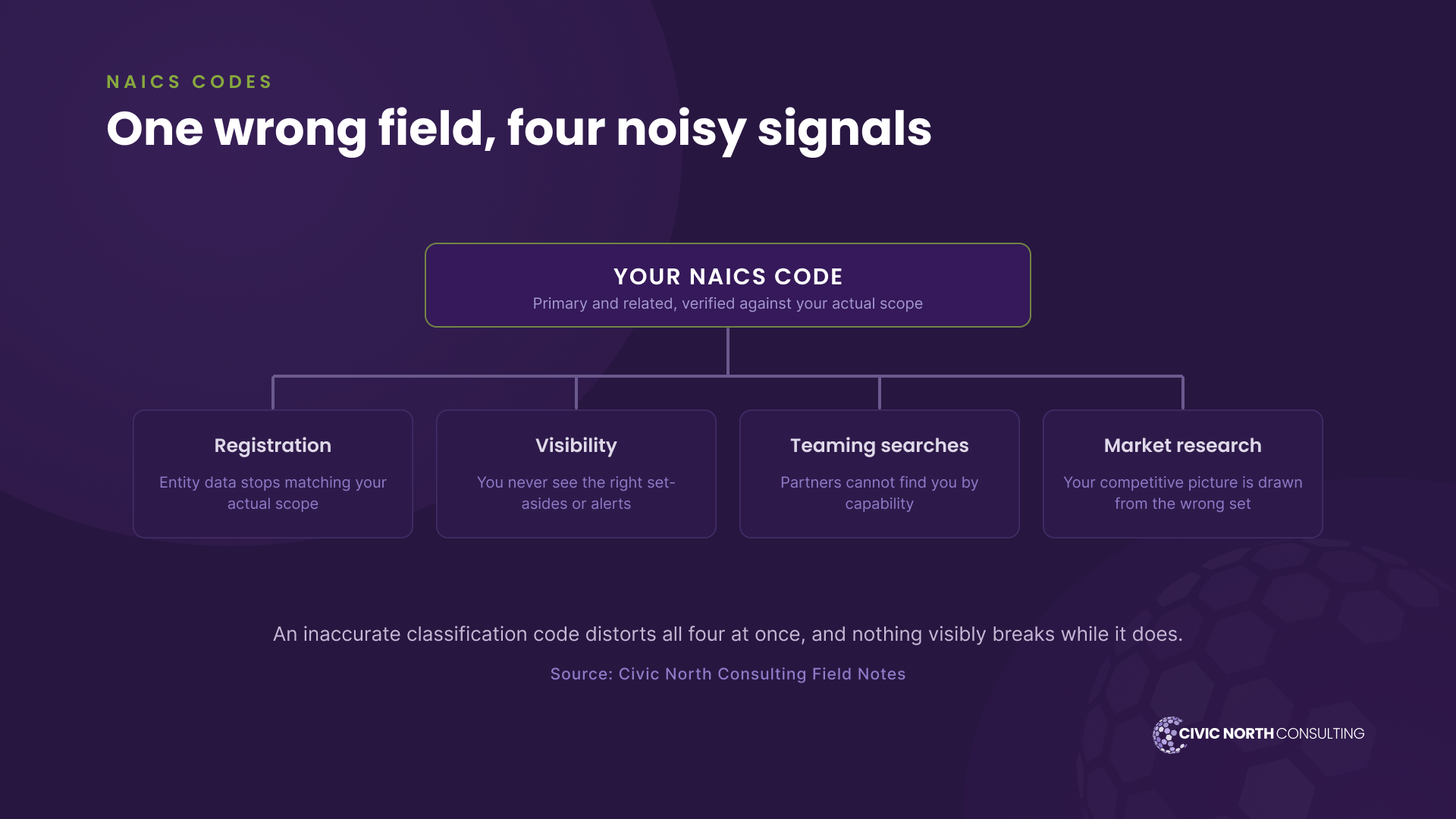
An inaccurate industry classification code distorts registration, visibility, teaming searches, and market research all at once. Infrastructure contractors often lose time deciding whether they belong under one classification or another. Meanwhile, their SAM data quietly stays wrong in the background. Failures here contribute to the high volume of bids that fail before submission.
Verify primary and related NAICS codes against Census and SAM guidance before you touch a solicitation. If the code is wrong, every signal that depends on it gets noisy. This includes alerts, set-aside logic, and teaming searches. Building a procurement-grade compliance matrix starts here, before the proposal draft. By proactively identifying every procurement compliance risk at this stage, you protect the entire bid from administrative disqualification.
How do you satisfy competitive requirements through cooperative vehicles?
A cooperative contract vehicle satisfies the competitive solicitation requirement; it doesn’t let anyone skip it. NASPO ValuePoint’s lead state model gives vendors a documented, compliant route into state and local pipeline infrastructure work. Other cooperatives, such as Sourcewell, OMNIA Partners, and HGACBuy, each use their own process. Check how the specific vehicle works before you plan around it. Relying on inconsistent proposal documentation in these high-volume environments is a common cause of lost opportunities. For firms developing public safety vendor proposals, these vehicles offer a streamlined but rigorous path to award.
What does a NASPO ValuePoint vehicle offer a vendor?
- Reach: NASPO ValuePoint contracts are available to public buyers across all 50 states, D.C. and U.S. territories (NASPO ValuePoint).
- Compliance by design: Master Agreements require approval from each chief procurement official and compliance with local statutory and regulatory provisions.
- Reduced duplication: State agencies, colleges, and local governments can use one award without a new solicitation each time.
- Lower procurement burden: Public procurement officials cite these contracts as reducing burden while increasing buying efficiency (NASPO ValuePoint).
How do you build the matrix for PHMSA and EPA pipeline solicitations?
Safety standards for pipeline bids are getting stricter. Vendors who treat DOT or PHMSA reports as boilerplate may be marked non-responsive. A compliance matrix for this work must map technical reporting fields and material specifications directly against the solicitation language. Success requires translating these raw engineering specs into procurement-grade narratives that allow federal evaluators to rank the project’s impact against specific program criteria.
Civic North calls this a Readiness Sprint. It’s a focused pass where the technical team and the proposal team sit together. They shred the solicitation against current PHMSA and EPA standards before a single paragraph of narrative gets written. Regulations shift. A matrix built against last year’s guidance will pass your internal review and still fail the evaluator’s checklist. Success depends on rigorous procurement expertise rather than generic sales coaching.
What should you do next for submission readiness?
Audit your SAM.gov registration and NAICS codes against your actual scope of work this week, not before your next deadline. For pipeline safety infrastructure vendors, building that procurement-grade foundation now is cheaper than rebuilding it after a disqualification.
If you want a second read on where your bids are losing points, our calendar is open.