Four solicitations are open at once. Each has its own forms, formats, and submission rules. The only complete record of what each agency wants sits in one person’s head. It also sits in another person’s inbox. That is the point where compliance stops being a checklist and becomes the likeliest reason you lose a bid you could have won. It arrives with growth. An occasional bidder can hold the details in memory. A pipeline cannot.
The fix is a compliance system that scales with pipeline volume, not headcount. Use one matrix template. Assign one owner per requirement. Do a final check against the finished document. This piece is for proposal and capture teams managing several live solicitations at once.
What does reactive compliance cost a high-volume pipeline?
Reactive compliance means tracking requirements by memory. Someone remembers which agency wants which form, which certification needs a signature and which attachment format the portal accepts. That works for one or two bids a quarter. At higher volume, the spreadsheet, or the person holding it, can become a single point of failure. A requirement buried deep in an RFP may go unnoticed. Margin goes to administrative overhead instead of win probability.
How does manual tracking compare with an automated matrix?
| Feature | Manual Tracking | Automated Matrix |
|---|---|---|
| Scalability | Low | High |
| Error Rate | High | Low |
| Resource Load | Heavy | Lean |
What gets a proposal ruled non-responsive?
A missing form, an unsigned certification, or the wrong attachment format can make a proposal non-responsive. This can happen before an evaluator scores any technical content. Clearing that gate gets the proposal read; it doesn’t earn points. The technical evaluation that follows is scored against published criteria and weights. A compliance system protects the bid’s chance to compete. The writing still has to win it.
How do you build a procurement-grade compliance matrix?
A compliance matrix tracks every mandatory requirement in a solicitation and shows exactly where the proposal answers it. Build it line by line against the RFP’s own section numbering, so nothing gets paraphrased out of existence.
Why does every “shall” statement get its own row?
Every “shall” statement in a solicitation goes into the matrix as its own row. A requirement with no row has no owner. An unanswered required item can make the whole proposal non-responsive. This can happen even if the rest is well written.
How do you keep the matrix reusable across solicitations?
Keep one matrix template. It should map recurring pipeline requirements to approved content. Include certifications, insurance, registrations, and standard forms. Each new solicitation then starts from that template, and the team only shreds what’s new. The template is also where your team’s lessons learned go, so a requirement that caught you once is mapped before the next solicitation arrives.
How can you manage peak RFP seasons without the overhead?
- Run every solicitation through the matrix template before assigning it to a writer. Check requirements before the drafting starts.
- Route each mandatory requirement to a single owner. Cross-referencing shouldn’t depend on tribal knowledge during a deadline crunch.
- Lock a final compliance pass 48 hours before submission. Check the matrix against the finished document rather than against memory.
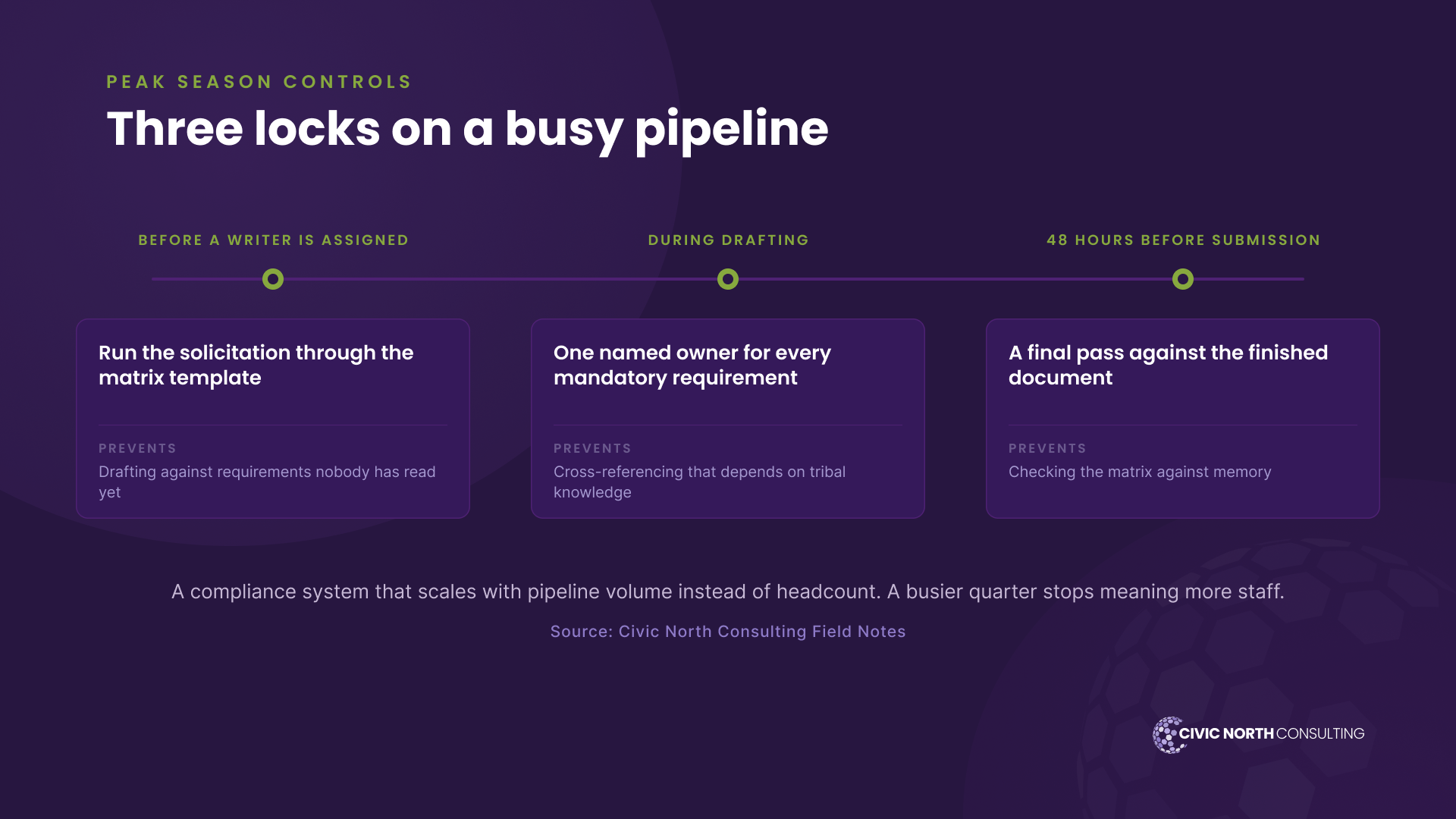
To make sure every bid survives the initial administrative review, build procurement-grade compliance infrastructure that shreds each solicitation into actionable requirements. Those systems scale with pipeline volume, not headcount. So a busier quarter does not mean adding staff to solve it again.
What should you do next?
Pull the last few proposals your team submitted and check each one against a matrix built from its own solicitation. Every requirement that was answered from memory is a place the next high-volume month will break. A Readiness Sprint on your proposal operations is the structured version of that audit.

If you want a second read on where your compliance system breaks under volume, our calendar is open.