We reviewed a technically superior bid that was tossed before the evaluators finished their coffee. What was missing? One missing signature, on one mandatory form. Nobody ever read the technical volume, which was arguably the best one in the pile.
This is a cross-referencing failure that a good compliance matrix would have caught.
What makes a compliance matrix procurement-grade?
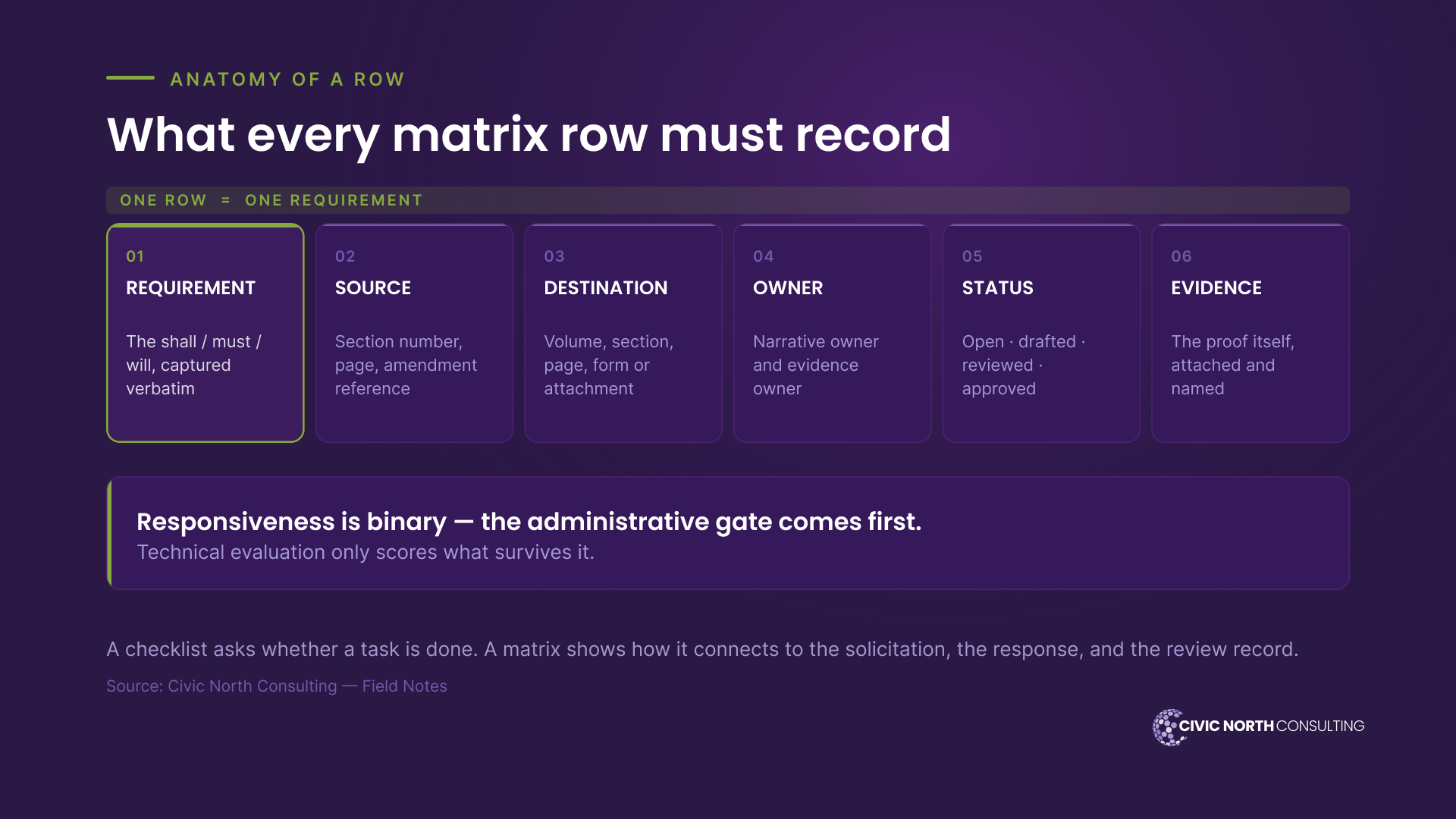
A procurement-grade compliance matrix turns the solicitation into an operating document. It records each requirement, its source location, and the response destination. It also tracks the owner, status, and evidence. The proposal then mirrors the solicitation closely. This allows an evaluator to verify compliance without searching.
Checklist or matrix?
A checklist asks whether someone completed a task. A matrix shows how the task connects to the solicitation, the response, and the review record. That distinction matters when contributors are drafting technical, management, pricing, and past performance sections at once.
The matrix also gives proposal managers a place to record page limits and forms. They can track attachments, signatures, file naming rules, and submission instructions. These details are what government contract compliance actually consists of.
What does responsive mean?
Responsiveness is a binary status. A submission either satisfies the solicitation’s mandatory requirements or it doesn’t. Technical evaluation is different. Evaluators score the substance of a response against stated criteria. Treating technical evaluation as binary hides the administrative gate that comes first. Failure at this gate leads to administrative disqualification, regardless of the quality of the narrative.
A proposal infrastructure review can expose that gap before the team begins polishing narrative.
How do you structure compliance matrix development?
Start with the document itself. Don’t start drafting prose and hope the requirements surface later.
- Shred the solicitation. Extract every shall, must, will, and required item. Include every submission instruction. Check requirements in attachments, forms, amendments, evaluation sections, and contract terms.
- Record the source. Give each item a section number and page reference. Add an amendment reference and requirement type. Mark whether it affects responsiveness, scoring, pricing, or performance.
- Assign the response destination. Map each requirement to a volume, section, page, table, form, or attachment. If the requirement has no destination, it does not have an owner yet.
- Assign an owner and review status. Name the narrative owner and the evidence owner. Name the compliance reviewer. Track open questions, dependencies, and approvals in the same row. This is also the time to ensure the team can communicate customer impact within the matrix constraints.
This is the working core of request for proposal (RFP) response tracking. It shows what must be written and where it belongs. It also shows who must confirm it. This prevents a common failure where an answer is hidden inside the proposal and hard to find.
Where does spreadsheet failure create procurement compliance risk?
A spreadsheet is useful right up to the point where its controls stop surviving handoffs and revisions. It has to hold through final production, which is where most of them quietly stop holding. Common failures:
- Broken references. A row points to an old section, a draft page, or a superseded amendment.
- Hidden rows or filters. A requirement disappears from view and never reaches the final review.
- Uncontrolled versions. Multiple files contain different owners, statuses, or interpretations of the same requirement.
Document hygiene failures reach past the administrative layer. One spreadsheet error nearly cost a $2M contract. The account of how it almost happened is worth reading. Read it before you trust your own version control. The matrix needs a named owner, controlled access, and a final line-by-line check against your submitted files.
How can pre-competed vehicles support compliance speed?
Cooperative purchasing vehicles can give an agency a pre-competed legal baseline for a buy. Sourcewell reports more than 50,000 participating public agencies across its cooperative contracts (Sourcewell on cooperative purchasing).
That baseline reduces duplicated solicitation work for the agency. It does not reduce your obligation to answer the requirements in front of you. The matrix still records every instruction for this response. It also lists local and federal terms the vehicle does not cover.
The final compliance audit
- Reconcile every row. Compare the matrix against the final solicitation and all amendments. Compare it against every submitted file.
- Test evaluator access. Open each referenced page, attachment, and link. Check form and signature blocks as an evaluator would.
- Run an independent review. Give the matrix and final proposal to someone who didn’t draft the response. Ask them to verify every mandatory item without help.
Compliance is the baseline. Nobody wins on it, and plenty of people lose on it. Your narrative can win the evaluation; the matrix is what gets you into the room where the evaluation happens. Take one live solicitation and build the matrix row by row before you touch another paragraph.
We do this review as a focused diagnostic sprint. We also run full proposal development and ongoing pipeline management. See how the engagements work.