A vendor may have an awarded GSA (General Services Administration) schedule. They may also have a strong product. But they may still not have a clear way to get into the next agency. That’s the gap between a sales coach and a public sector strategy consulting partner. One works on conversations. The other works on procurement access, compliance, and evaluator scoring.
For GovTech and public safety vendors, the key factor in scaling public sector sales is often the buying path. While the product must work well, a winning strategy must do more. It must support the integrated data chains that agencies now prefer. It must also move away from legacy, siloed product strategies. A strategy firm must know how to move these complex, interconnected solutions through the bureaucracy.
Why does general consulting fail the GovTech vendor?
What generic sales coaching misses
Sales coaching can improve discovery calls and follow-up habits. It cannot fix an ineligible solicitation. It cannot restart an unused contract vehicle. It cannot restore a required form that no one attached. These are procurement problems. A better feature set or discovery framework does not solve them. In government markets, a formatting slip can end a multi-million dollar pursuit. As one spreadsheet very nearly proved.
We look for firms that can connect capture planning to proposal operations. A strong public sector proposal development process turns technical material into a compliance matrix and an evaluator-ready narrative. It creates a submission that answers the solicitation in its own terms. Implementing proposal infrastructure for government responses is a core part of that work.
Regulatory hurdles are market-entry work
A strategy firm should identify the regulatory hurdle before recommending a campaign. That means checking if an awarded vehicle reaches the target agencies. It also means checking if the scope fits the product. Finally, check if the vendor can meet the contract terms after signing.
The distinction is simple. A firm that prepares you to “win the RFP” is solving one event. A procurement strategist is building a route you can use again.
How do cooperative purchasing vehicles and public sector strategy consulting open the route?
Cooperative purchasing vehicles are a primary route into GovTech scaling, and they are not a way around procurement. They are procurement, already completed. A lead agency runs a compliant competitive solicitation. Eligible agencies then buy using that award. They do not need to run the same process again. Sourcewell reports more than 50,000 participating public agencies across its cooperative contracts (Sourcewell on cooperative purchasing). Knowing how Sourcewell procurement works can cut the time a local government needs to buy from you. The competitive step was already done properly, not skipped.
What the vehicle changes
- Access: An awarded vehicle can put a vendor in front of agencies. Those agencies do not need a new standalone solicitation.
- Qualification: The vehicle’s contract terms and evaluation work create a procurement record agencies can use. State master agreements can carry similar weight in many jurisdictions. This is shown in this NASPO ValuePoint award for public sector technology modernization.
- Planning: Capture teams can prioritize agencies by fit, timing, and purchasing authority.
- Execution: Sales, contracts, and proposal staff can work from one documented route instead of improvising for every opportunity.
State-level master agreements serve a related purpose, advancing technology modernization across multiple jurisdictions. That makes them relevant to vendors seeking broader state access, provided the product and the contract scope actually align.
What should a public sector strategy firm provide?
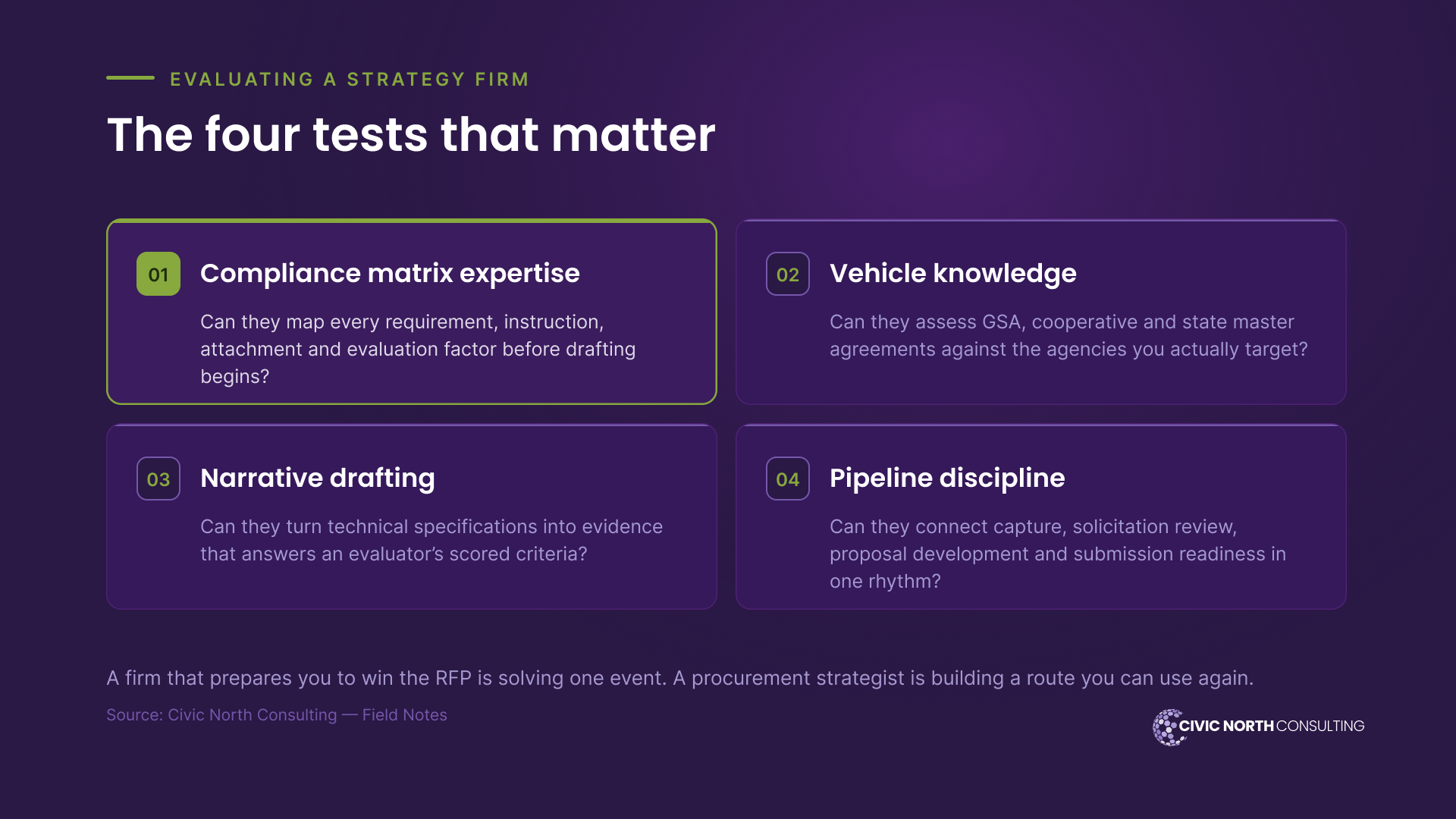
Rank a strategy firm on procurement capability rather than presentation quality. We test each firm against four practical criteria:
The four tests
- Compliance matrix expertise. Can the team map every requirement, instruction, attachment, and evaluation factor before drafting begins?
- Vehicle knowledge. Can it assess GSA, cooperative, and state master agreements against the agencies and use cases the vendor actually targets?
- Narrative drafting. Can it translate technical specifications into evidence that answers an evaluator’s scored criteria?
- Pipeline discipline. Can it connect capture, solicitation review, proposal development, and submission readiness in one operating rhythm?
What you need is a partnership that works both sides of that line: the policy and contract terms on one side, the technology being sold into them on the other. Responsiveness is binary. The submission either follows the instructions or it is out of the running before anyone reads the technical volume. Technical evaluation is a points-scored ranking of whatever survived that gate.
James Q. Wilson explained the mechanism behind that in the standard text on how government agencies actually operate. Business management watches the bottom line, he observed, while government management is:
“…driven by the constraints on the organization, not the tasks of the organization.”
James Q. Wilson — Bureaucracy: What Government Agencies Do and Why They Do It, 1989
An evaluator is not rewarded for identifying the best product. They are protected for running a defensible process. A non-compliant submission is a threat to that defensibility, so removing it is the correct action regardless of what sits inside the technical volume.
That is why compliance is a gate and merit is a score. A firm acting as a trusted partner protects both and never treats one as if it were the other.
Moving from reactive bidding to pipeline management
Plenty of vendors track contract motion and call it pipeline. They know an agreement was awarded, a buyer seemed interested, a solicitation might appear. What they cannot tell you is which vehicle fits the next opportunity. They also cannot tell you what past-performance write-ups can be reused. The same is true for security documents, certifications, and pricing narratives. They cannot tell you what can be reused without a rewrite. They also cannot tell you who owns the next compliance review.
Audit every awarded vehicle against target agencies, eligible scope, required evidence, and live opportunities. Then mark each one active, misaligned, or dormant. Pay attention to dormant. That category tends to hold access the sales team has been mistaking for strategy.
What to do next
Review your awarded vehicles this week. Record the agencies they can reach. Note the products they cover. List the next realistic procurement step to activate the pipeline.
If you want a second read on where your bids are losing points, our calendar is open.