We watched a team spend six weeks on a state solicitation. The winning price was below their margin floor. The only person in the agency who supported them left in March. They submitted anyway. Compliant, responsive, and third.
Neither of those facts was a surprise on submission day. Both were knowable in week one.
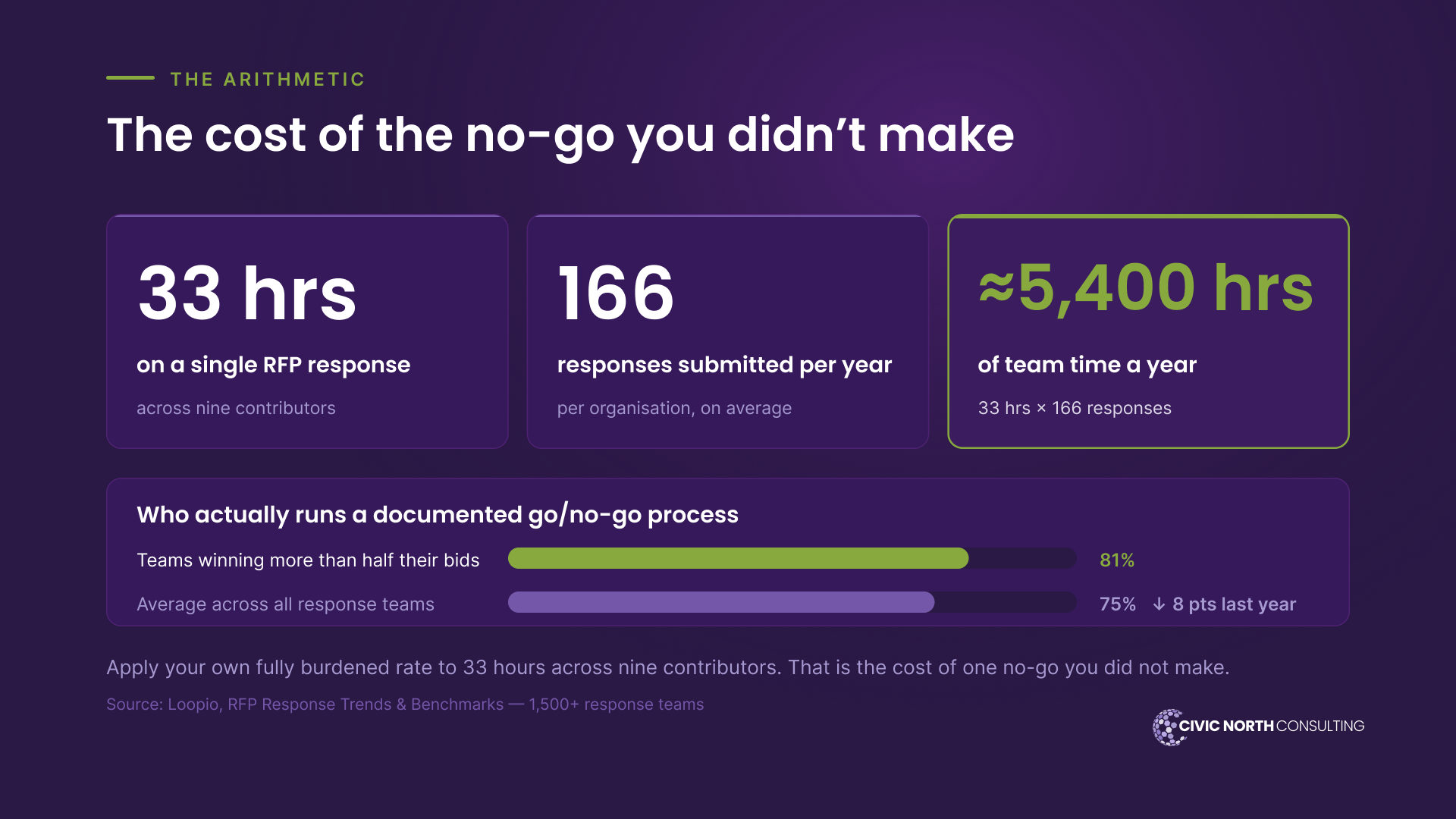
A go/no-go framework kills a proposal before the first draft, back when killing it is cheap. Here is the arithmetic on skipping it. Teams spend about 33 hours on one RFP response. Nine people often help with the work. Price has been the top reason bids are lost each year since 2021. (Loopio RFP Response Trends and Benchmarks, 1,500+ response teams) Apply your fully burdened rates to 33 hours across nine contributors. That equals the cost of one no-go you avoided. The lost bid is the smaller number.
Why do RFP responses fail before the first draft?
The procurement solicitation process includes more than writing. Sourcewell’s own solicitation documentation sets out multi-step timelines with pre-proposal conferences and question periods that take real administrative bandwidth (Sourcewell solicitation process). That sequence needs coordination, not a single writing assignment.
That sequence creates narrative fatigue. Teams rewrite similar company descriptions and chase internal reviewers. This keeps technical staff on deals that may never fit. Revenue pressure can make these decisions feel emotional. A documented process helps leaders see when a team is too stretched to win. Setting a baseline for what you can actually prove about your value turns go/no-go into a diagnostic rather than an argument.
Responsiveness is binary. A submission either satisfies the stated administrative requirements or it doesn’t. Technical evaluation is different. Evaluators rank the merits of a compliant response against the solicitation’s criteria. Treating those stages as the same creates avoidable confusion.
Technical setup, valid tax IDs, and browser requirements can block a submission. Procurement portals need specific registration and technical setup. This acts as a basic compliance gate. It happens before anything important is reviewed (Sourcewell procurement portal FAQ). Putting those admin steps first in the compliance matrix helps you avoid mistakes in your paperwork. It also helps you avoid losing an award to documentation errors. These errors have nothing to do with solution quality.
How does an RFP go/no-go framework score the opportunity?
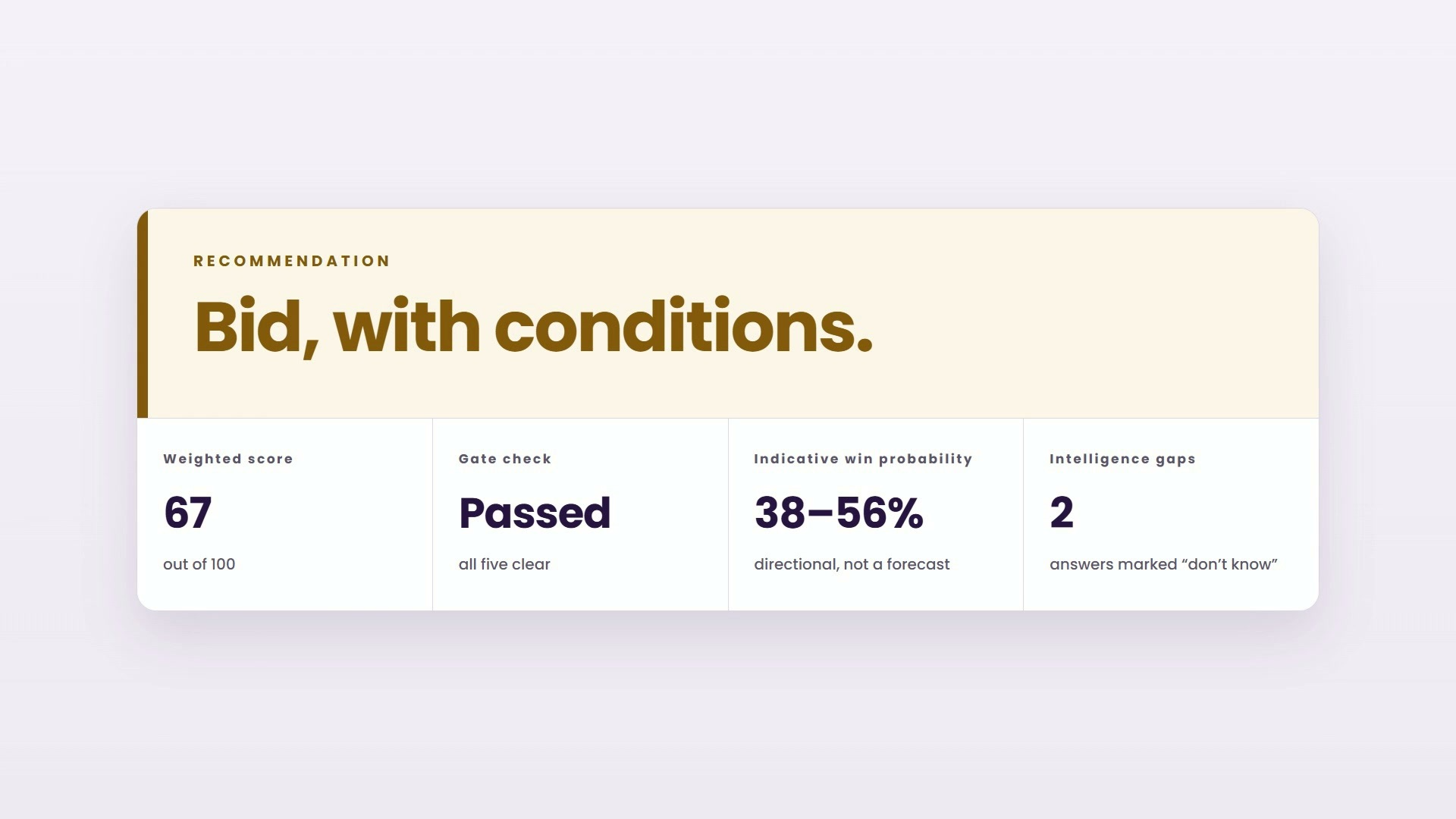
A proposal response framework makes the team record its judgment before the pursuit gathers emotional momentum. Use a bid scoring model with a consistent scale, like 1 to 5. Give more weight to factors that show if you can win. If you want a version your team can run today, our Bid Decision scorecard takes about five minutes. It starts with a five-question gate check. One “no” means no bid, no matter the score. Next are seven weighted categories. You also get an estimated win probability. It ends with a list of what you just said you do not know. It follows the bid/no-bid structure in the APMP Body of Knowledge and runs entirely in your browser.
- Incumbent advantage: Score the incumbent’s known relationship, contract position, switching risk, and evidence of customer familiarity.
- Budget transparency: Score how clearly the solicitation defines funding, pricing expectations, and the buyer’s purchasing path.
- Mission alignment: Score the fit between the requirement and the vendor’s core capabilities, references, and delivery model.
- Compliance readiness: Score the completeness of registrations, tax information, technical access, forms, and required signatures.
- Capacity at submission: Check if the team can handle capture, questions, pricing, approvals, and production. Confirm this work will not replace a stronger pursuit. This is a resourcing question and a scheduling one. That is why forecasting headcount against pipeline belongs in the same conversation.
Record the reason behind every score. A low score supported by a documented condition is useful. A high score based on hope is a polished form of risk.
What is the cost of losing?
The hurdle here is emotional, not analytical. Nobody wants to leave money on the table, which quietly assumes the money was ever on the table. It was not.
Richard Thaler named both halves of that failure in the 1980 paper that helped found behavioural economics. Among the systematic errors he identified in how people actually decide:
“…underweighting of opportunity costs, failure to ignore sunk costs.”
Richard Thaler — “Toward a Positive Theory of Consumer Choice,” 1980
The two run together on a live pursuit. Six weeks in, those six weeks are gone and cannot be recovered by submitting. That is the sunk cost, and it should carry no weight in the decision at all. Meanwhile the pursuit you did not staff properly is the opportunity cost, and it stays invisible because it never appears on anyone’s timesheet.
A go/no-go framework is a device for making the second visible and the first inadmissible. What is on the table is compliance work, review cycles, and a competitive evaluation you might lose. The real cost of losing includes hours you cannot get back. It also includes better chances that got less attention while you were busy.
A practical diagnostic asks what the organization gives up by pursuing this bid. Run it against your own portfolio rather than a feeling. Organizations submit about 166 responses each year. Each response takes about 33 hours. That adds up to about 5,400 hours of team time. They now answer only 55% of the RFPs they receive, down from 63%.
So, someone already declines a meaningful share of that volume. Teams that win over half their bids use a go/no-go process 81% of the time. The average is 75%, down eight points from last year (Loopio). Industry averages only get you so far, though. For a specific opportunity, the Bid Decision scorecard uses contract value and gross margin. It also uses your cost to pursue. Then it returns the expected value of bidding. It uses your indicative win probability. That is the number the decision meeting actually needs. Proposal infrastructure reduces that exposure before narrative quality is even a factor.
What are the next steps for the proposal team?
Readiness is a diagnostic process. A strong narrative matters only after the submission survives the evaluator’s initial compliance review. A team chasing every solicitation without a formal diagnostic is burning capacity on non-responsive bids.
Review your internal proposal process. Build the compliance matrix. Set firm decision rules before your next high-stakes solicitation goes into production.
Not sure whether a solicitation is worth pursuing? Score it on the Bid Decision scorecard first. If the score and your instinct disagree, book a diagnostic call and we will work out which one is wrong. Thirty minutes, no deck.