Grant pipeline management usually breaks before anything gets submitted. A rural nonprofit waits for a request for proposals, pulls program staff from their real work, and writes a compliant response fast. The need is real. The process is still expensive, and the people paying for it are the ones running your programs.
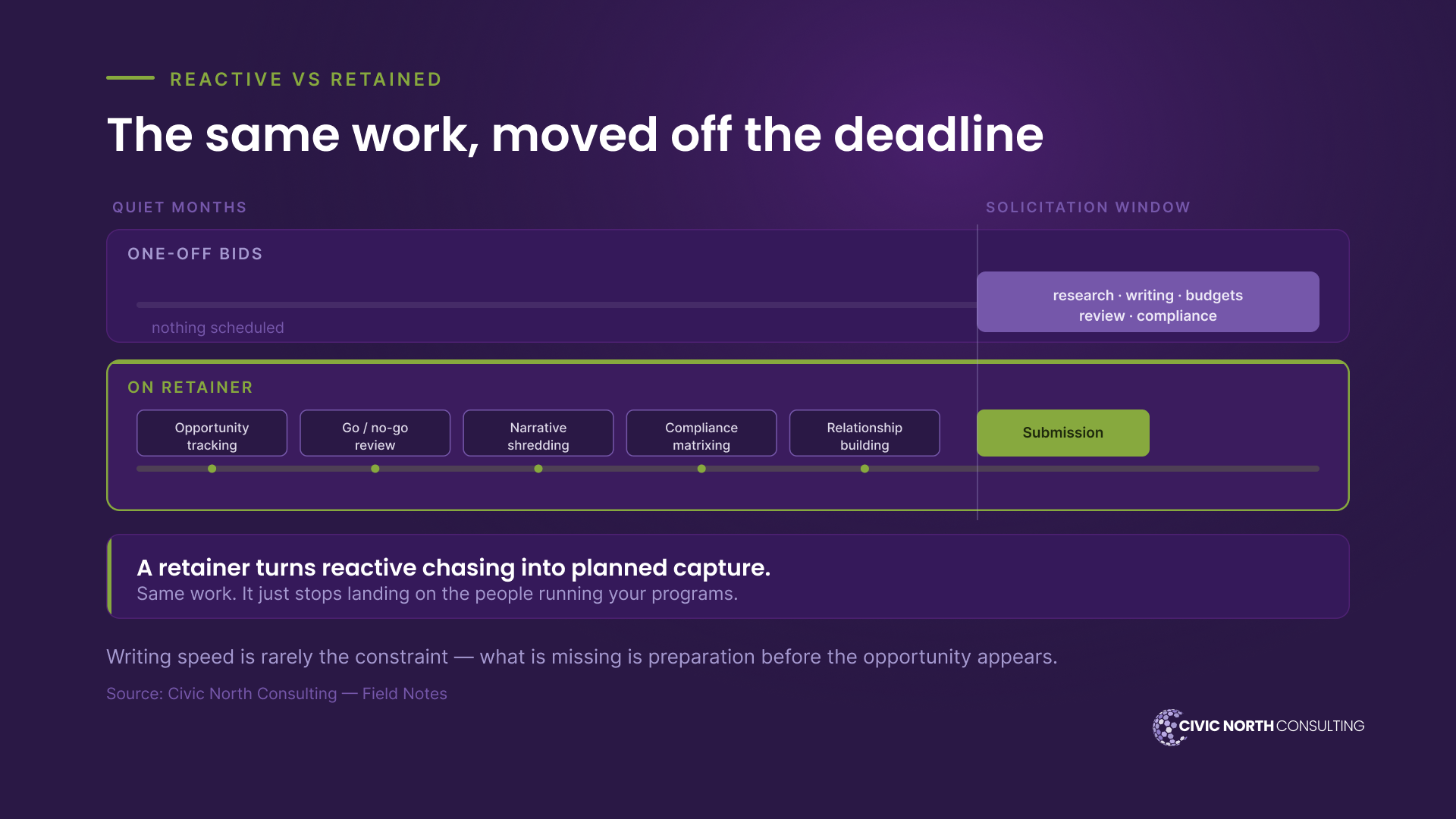
A retainer changes the work from reactive chasing to planned capture. That matters most for organizations with limited grant capacity, where one missed attachment can make an application non-responsive. Working out what you can actually prove is easier to do in February than the week before a deadline.
Why does the one-off project model fail your team?
The hidden cost of internal fatigue
One-off bids concentrate research, writing, budgeting, and review into the same narrow period. Staff members who already manage housing programs, education services, or public operations become the emergency grant team. That fatigue shows up in judgment and in documentation, which is how one spreadsheet error nearly cost a $2M contract.
We have found that writing speed is rarely the constraint. What’s missing is preparation before the opportunity appears. A reusable evidence library, current program language, and an agreed approval process reduce new work for each submission. That’s the practical benefit of a grant writing retainer. The same math that makes a fractional specialist cheaper than an agency applies here.
We have found that the core problem isn’t writing speed. It’s the absence of preparation before the opportunity appears. A reusable evidence library reduces new work for each submission. Up-to-date program language also reduces new work. An agreed approval process further reduces new work for each submission. That’s the practical benefit of a grant writing retainer.
Peter Senge gave this pattern a name. It is the fourth of his laws of systems thinking:
“The easy way out usually leads back in.”
Peter Senge — The Fifth Discipline, 1990
His warning was sharper than the usual point about quick fixes. A familiar solution, he wrote, can be ineffective and even addictive. The most harmful result is needing more of it.
That describes the one-off model exactly. Each emergency scramble creates a submission but no reusable asset. So the next solicitation needs the same scramble. Each cycle, the ability to do anything else shrinks a little more. A retainer is not a faster way to write. It is a decision to stop paying the same setup cost every time.
Compliance risks in the last hours
Reactive bidding also leaves little time for compliance matrixing. Requirements get interpreted in isolation and attachments are gathered late, which buries technical strengths under avoidable omissions. It is the same core issue. It explains why so many RFP responses fail before they are even submitted. Response quality depends on the system built around the narrative.
What belongs in a grant pipeline management strategy?
A retainer should create useful work between solicitations rather than a growing pile of generic drafts nobody will use. A practical program includes:
- Opportunity tracking: Monitor funders, public notices, eligibility changes, and likely release windows.
- Go/no-go review: Compare mission fit, capacity, evidence, match requirements, and compliance burden before committing staff time.
- Narrative shredding: Break prior responses into reusable claims, proof points, outcomes, and supporting documents.
- Compliance matrixing: Map every requirement to an owner, source document, response location, and review status.
- Relationship building: Maintain informed contact with funders and public-sector stakeholders before a deadline creates pressure.
Building procurement-ready narratives
Procurement-ready writing connects a community need to an operating plan. It links measurable activities, responsible staff, and credible evidence. It gives evaluators a clear path from requirements to responses, not broad impact claims.
That discipline also supports nonprofit grant readiness. Organizations can identify missing policies, weak evidence, and unclear program ownership while there’s still time to correct them. It helps to know that the first reader may not be human, because that changes how you structure a document.
How do cooperative purchasing contracts affect planning?
Cooperative purchasing contracts reward proactive positioning. Lead state contracts can give agencies access to pre-negotiated terms. This includes NASPO ValuePoint. This changes how vendors and public-service partners should prepare for opportunities. For people working in specialized fields like public safety networks, integrated data chains are becoming more common. Long-term planning is essential.
For a nonprofit working alongside a government partner, the lesson is short. Don’t wait for a new RFP to tell you where your services fit. Track the awarded vehicles and learn the requirements. Be ready to explain the problem you solve in two sentences when someone asks.
How can you assess nonprofit grant readiness?
- List the next three targets: Record eligibility, deadline, required attachments, match rules, and decision criteria.
- Run a capacity check: Identify who owns research, writing, budgets, approvals, data, and final compliance review.
- Mark the gaps: Separate missing evidence and policies from tasks that staff can complete with existing material.
- Choose the operating model. Decide if your team can handle the compliance workload. Or choose a grant writing retainer for more predictable support. This is the same choice every small organization faces on fractional versus full-time capacity. The honest answer is that you may not need us yet.
A retainer turns grant seeking from an expense tied to emergencies into a managed funding process. It also has a cost. That cost is worth weighing against what you spend now. Consider staff hours and platform fees. Schools have done this when reviewing what platform fees actually cost a program. Run the go/no-go diagnostic on your next three targets before assigning anyone to write.
One thing worth stating plainly: our fees are never contingent on a grant award. You pay for the work and the discipline, not a percentage of someone else’s decision.
If you want to talk through which model fits your team, our calendar is open. Thirty minutes, and we’ll tell you if you don’t need a retainer.