A municipal project can stall exactly where sound engineering meets an evaluator’s scorecard. The bridge or broadband build is described with real technical accuracy, but the funding case still cannot be ranked. The engineering is there. The procurement-grade narrative is not.
Why aren’t technical specs enough for infrastructure grant writing?
Federal assistance is organized through rigid program requirements and reporting expectations. Finding a relevant program is only the first step. The application must show the project fits the listing’s purpose. It must also match the agency’s evaluation method. Screening is often automated before anyone reads it, and knowing that the first reader may not be human should change how you structure the document: headings that match the listing’s criteria, requirements answered where a reader expects them, and evidence attached rather than referenced.
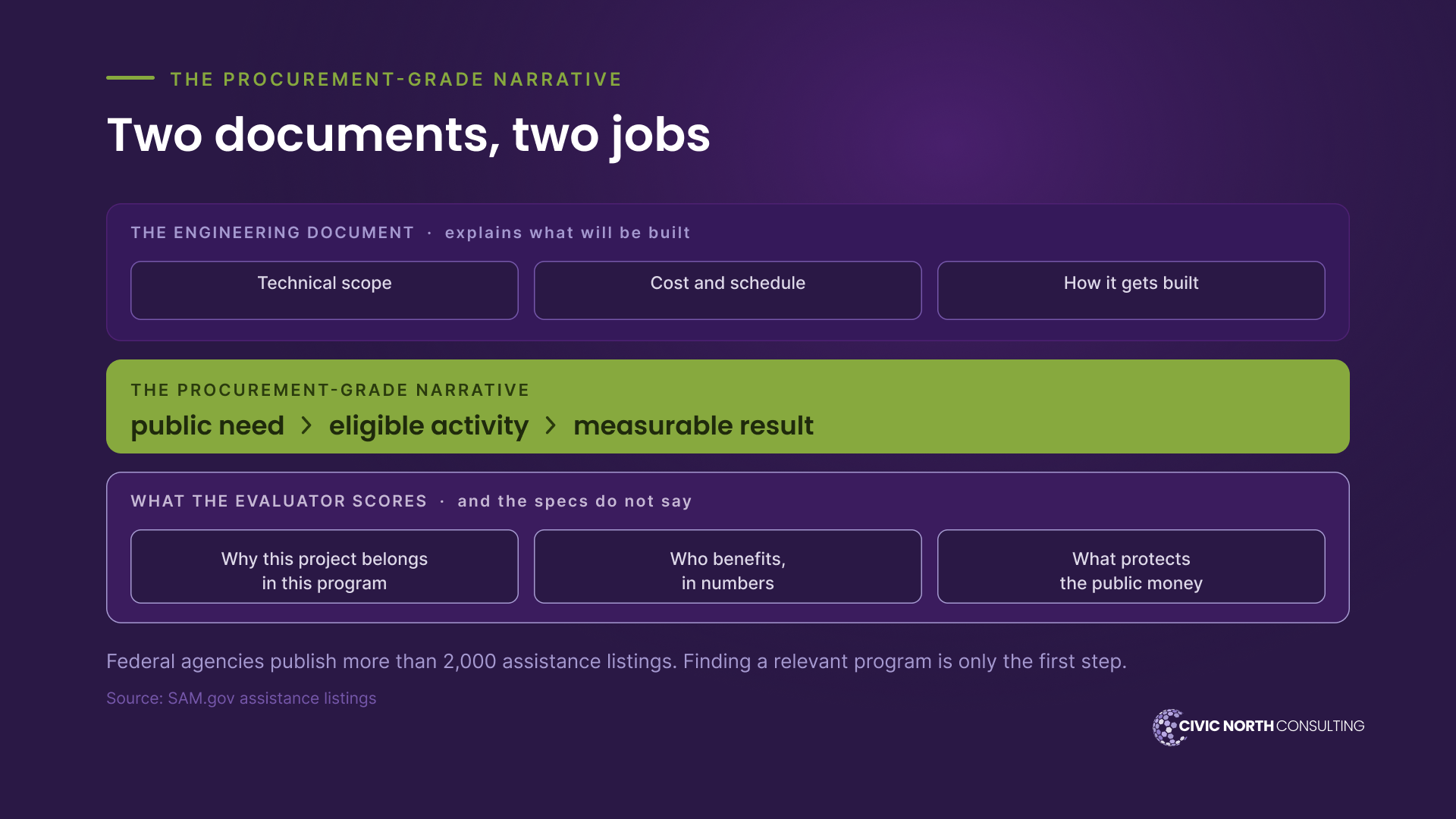
Federal agencies publish more than 2,000 assistance listings that municipalities have to navigate (SAM.gov assistance listings). For a rural town without grant staff, research takes up time needed to define the project.
Engineering documents explain what will be built. A grant narrative has to explain why this project belongs in this program, who benefits, and what protects the public money once it arrives.
James Scott spent a career on what he called legibility: the problem of a state being unable to see what it has no standard way of measuring. Describing the premodern state, which knew almost nothing about its own subjects, he identified the missing piece as:
“…a metric that would allow it to ’translate’ what it knew into a common standard.”
James C. Scott — Seeing Like a State, 1998
Scott’s sympathies were with local knowledge, and he was clear-eyed about what standardisation costs. But the mechanism runs both ways. A federal evaluator cannot review a project if it is not in the program’s categories. The project may still have solid engineering.
The narrative is not decoration applied to the specs. It is the metric that makes a bridge in one county comparable to a bridge in another. This is the only basis for ranking either bridge at all.
Evaluators want a clear line from public need to eligible activity to measurable result. A readiness check on what you can prove can help you find any missing link early.
How can local growth be aligned with federal priorities?
The right assistance listing gives the application a starting point. Alignment is what gives it a reason to be picked. A municipal infrastructure grants narrative links local conditions to the program’s stated priorities. It avoids a broad list of community needs. This keeps a strong project from seeming unfocused.
- Start with eligibility: Confirm the assistance listing, applicant type, eligible costs, match rules, and required attachments.
- Translate the project: Convert engineering scope into plain language about service reliability, safety, access, resilience, or economic function.
- Map the public benefit. Identify residents, businesses, facilities, or systems that are affected. Link each benefit to the stated program priority. Community funding cases depend on this. The lessons from funding high school athletics apply at any scale. Name who benefits, in numbers, before you describe what gets built.
- Build the compliance matrix: Assign every evaluation criterion to evidence, an owner, and a place in the narrative.
- Check the implementation path: Show procurement, permitting, schedule control, reporting, and risk management in terms an evaluator can verify.
The narrative should read like a controlled response to a solicitation. Reusable content libraries and compliance matrices make omissions visible and reduce the cost of response. This is why establishing proposal infrastructure is a prerequisite for long term success.
How does cooperative purchasing support execution?
An award establishes funding, but the municipality still has to move from authorization to acquisition. Cooperative purchasing organizations provide pathways that reuse an already-awarded solicitation, which can streamline execution where local rules permit it. Local governments can access those pre-competed contracts to reduce administrative lead times (Sourcewell for local government).
Review this option during planning rather than treating it as an afterthought. The grant narrative, procurement plan, and implementation schedule must match. An evaluator will notice if they do not.
How can grant readiness be built?
Strategic readiness steps
- Inventory the pipeline. List each local project, its engineering status, likely funding source, and unresolved eligibility questions.
- Build the evidence file. Collect needs data, maps, cost documentation, permits, partnerships, and procurement assumptions in one location.
- Run a scorecard review. Test the draft against every criterion. Revise any section that describes activity without proving alignment or readiness.
Compliance is the baseline. A strategic narrative is what makes the project legible to the evaluator. Review your current pipeline and identify which application needs a procurement-grade rewrite before submission.
If you want a read on which of your applications is closest to fundable, our calendar is open.