Four solicitations land inside the same three weeks. The team has already been working hard. What needs to change is how those four opportunities get qualified, staffed, and prepared. That is the only variable we can still move.
So it shows up in small misses. A wrong contract number in a past-performance write-up that has shipped nine times. And sometimes it shows up as social engagement. An eye-roll when someone schedules the Pink Team review. Both look like attitude from a distance. Up close they are the first measurable output of a capacity problem that started at bid/no-bid.
Why does proposal burnout show up as a quality problem first?
The WHO defines burnout in ICD-11 as a syndrome caused by long-term workplace stress that is not well managed. It has three parts.
- First, you may feel drained or exhausted.
- Second, you may feel distant from your job and become cynical.
- Third, you may feel ineffective or feel like you are not accomplishing much.
A bid team hits all three in a clear order. The order helps because it shows how much time you have left.
What does burnout look like in a bid team?
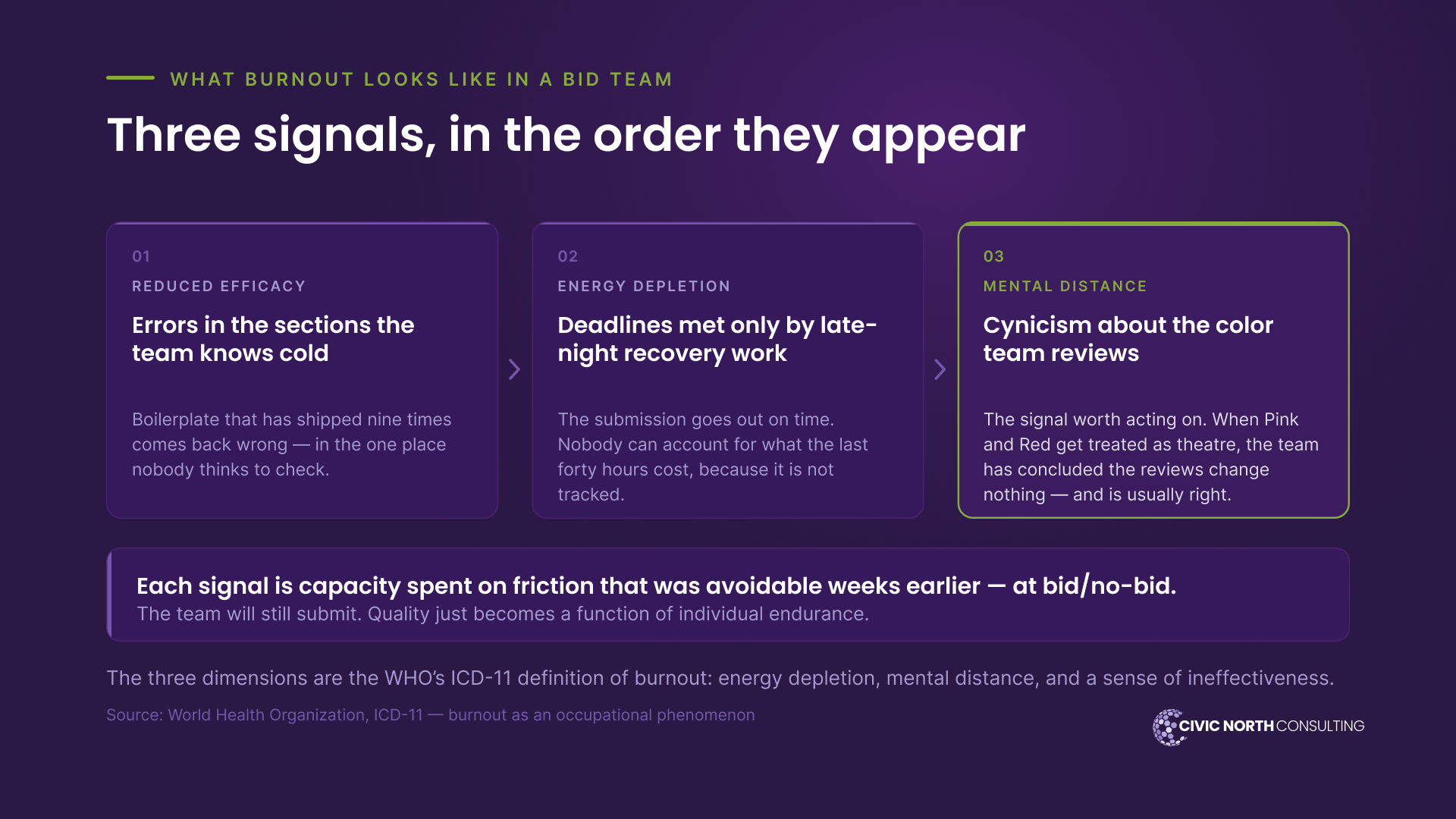
Errors in the sections the team is typically solid in. The boilerplate that has gone out nine times comes back wrong. Reduced efficacy, showing up in the one place nobody thinks to check.
Deadlines met only through late-night recovery work. The submission goes out on time. Nobody can account for what the last forty hours cost, because the cost is not tracked anywhere.
Cynicism about the color team reviews. This is the signal worth acting on. When people treat Pink and Red like theater, they believe reviews will not change the outcome. They are usually right. The reviews were scheduled too late to change anything.
Each one is capacity being spent on friction that was avoidable weeks earlier. The team will still submit. Quality just becomes a function of individual endurance.
What belongs in the content library before the RFP drops?
Reviewed technical narratives. Staff resumes with a review date on them. Past-performance language has already been checked against the contract file. So the numbers in it match what happened.
Writers who have that on day one spend the solicitation window on what is actually specific to this bid. Writers who do not spend it rebuilding material that already existed in three versions across two drives. Version control is part of the library, not housekeeping to do later.
[VERIFY: internal link to the relevant civicnorthconsulting.com field note on content libraries, if one exists]
How should teams professionalize the go/no-go decision?
Bid/no-bid sits in capture planning, not in proposal development. The APMP BOK keeps those phases separate for a reason. By the time the proposal manager gets the file, it is too late. The decision to protect capacity has already been made. Or it was not made at all. The team inherits whatever came of it.
Four questions, answered on the record, before anyone is committed:
- Strategic fit. Does the requirement match the contract vehicle, the capabilities, and the customer already being served?
- Evidence. Can the team support the technical and past-performance claims an evaluator is going to score?
- Responsibility. Can the organization actually perform this at this staffing level on this schedule? That is a separate determination from whether it can write a good response, and it is the one most often skipped.
- Capacity. Are the right contributors available through submission and the full review cycle, not just the writing window?
Compliance and responsiveness come later, in the shred, and they are two different tests. Compliance is meeting the stated requirements. Responsiveness is clearing the mandatory submittal gate, which is binary. Miss it and nobody reads the technical volume at all.
A no-go is a resource allocation decision. Read it that way and it stops being a referendum on whether the team is tough enough.
How do readiness sprints reduce administrative friction?
Readiness sprints move work out of the solicitation window and into the quiet weeks before it. This is the only time the work fits without costing someone a weekend.
Tom DeMarco wrote a book about this, and its subtitle names the failure mode exactly: Getting Past Burnout, Busywork, and the Myth of Total Efficiency. His definition of the thing organisations reliably cut first:
“Slack is the degree of freedom in a company that allows it to change.”
Tom DeMarco — Slack, 2001
His argument is that a team at full utilization cannot handle unplanned work. It becomes slow and brittle because it is too efficient. Four solicitations inside three weeks is the unplanned event. A team already at capacity cannot take it on. The cost shows up in weekend work and errors in boilerplate nobody checked.
Readiness sprints are a way of buying that slack in advance. The work does not get smaller. It gets moved into weeks that had room in them.
Who owns what, and by when?
Name an owner for capture, solution design, pricing inputs, compliance, and production. Name an owner for each color team review: Pink, Red, Green, Gold, and White Glove. “Final review” is a placeholder. The review is Gold Team, it has an entry condition, and someone owns whether that condition was met.
Shred the requirements before writers start. Shall, must, and will are mandatory. Should and may are not mandatory. We still evaluate them. So they stay in their own column. We do not drop them as optional. Build the compliance matrix from the shred, not from the table of contents.
Automation earns a place where it removes repetitive searching, version checks, and document assembly. It does not earn a place in the parts that require judgment. Evaluators are reviewing more AI-drafted submissions than two years ago. One tender evaluator reports more bids in recent competitions. In 2023, some drew three or four bids. Now, they often draw twelve to fifteen. A response an evaluator can follow, with evidence for each claim, is worth more in a pile that size. It was worth less in a smaller one.
[VERIFY: internal link to the civicnorthconsulting.com field note on compliance matrices or requirement shredding]
What should a team do before the next solicitation?
- Write the go/no-go criteria now, while nothing is due.
- Audit the content library and retire anything without an owner or a review date.
- Name owners for each stage and each color team review.
- Shred likely requirements in advance and build the compliance matrix from the shred.
- Track avoidable rework after submission and fix its source before the next cycle.
Pick one opportunity already visible on the horizon and make the qualification call early. Write down what the team will prepare before the solicitation drops. Then put the Pink Team date on the calendar now, three weeks earlier than it would otherwise get scheduled.
A proposal team facing four solicitations at once has already been told to work harder. What it does not have is a system that changes how opportunities get qualified, staffed, and prepared. When every RFP feels urgent, missed details and eye-rolling during compliance checks are not attitude problems. They are symptoms.
Why are proposal fatigue solutions an operational priority?
Proposal fatigue is usually a workload-management failure before it becomes a people problem. Tight deadlines, complex needs, and unclear ownership push specialists to switch between many tasks. They juggle capture, pricing, and technical writing without enough time to recover. When these cycles become the default, they lead to chronic workplace stress. This affects people before it shows up in performance numbers. Managers can reduce that friction directly, and peak season is when it matters most.
What does burnout look like in a bidding team?
Three signals, in the order they usually appear. Recurring errors in sections the team knows cold. Deadlines that only get met through late-night recovery work. And growing cynicism about compliance checks is worth taking seriously. It means someone has decided the process is theater. Each signal points to capacity being spent on avoidable friction. The team will still submit. Quality just becomes a function of individual endurance.
Proposal infrastructure benefits
The practical fix starts with a reusable operating base. Adopting a rigorous proposal infrastructure approach helps writers access approved materials and compliance tools early. This happens before the solicitation adds pressure. It also fixes key errors that cause most bids to fail. This preparation allows an organization to reduce proposal stress without pretending that procurement deadlines are flexible.
How should teams professionalize the go/no-go decision?
A no-go decision protects capacity when an opportunity has weak alignment or not enough preparation time. Standardizing it also stops the team relitigating the same four questions every fortnight. Before committing anyone, check that you can actually demonstrate impact to an evaluator.
Qualification checklist
Use a short qualification check:
- Strategic fit: Does the requirement match the organization’s contract vehicle, capabilities, and target customer?
- Evidence: Can the team support the technical and past-performance claims the evaluator will score?
- Capacity: Are the right contributors available through submission and review?
- Compliance: Can the team produce a responsive offer within the actual internal schedule?
A no-go is a decision about resource allocation, and it should be read that way rather than as a verdict on the team.
How can readiness sprints reduce administrative friction?
Readiness sprints move work from the solicitation window into the preparation cycle. A procurement-grade content library should contain reviewed technical narratives, resumes, and past-performance language. Version control is part of that, and one spreadsheet error nearly cost a $2M contract. Getting this in place means every contributor knows what they own before the clock starts.
Roles and automation
Clear roles matter just as much. A proposal response framework should identify who owns capture, solution design, pricing inputs, compliance, production, and final review. An outsourced proposal team can add capacity during peaks. Meanwhile, senior-level proposal expertise can clarify the response structure before writers spend time polishing the wrong content.
Automation supports the same goal when it removes repetitive searching, version checks, and document assembly. As AI-made submissions become more common, a narrative a human evaluator can actually follow matters more. It does not matter less. The principle is plain: let the tools carry the administrative load so human attention goes to judgment and evidence.
What should teams do next for sustainable bidding?
- Set go/no-go criteria before the next solicitation arrives.
- Audit the content library and retire material that lacks an owner or review date.
- Map proposal roles to each Shipley-aligned stage of the response process.
- Run readiness sprints for likely requirements, compliance matrices, and evidence.
- Measure avoidable rework after submission and fix its source before the next cycle.
Start with one upcoming opportunity. Make the qualification decision early, then document what the team will prepare before the solicitation drops. High performance that depends on individual endurance is not performance; it is a loan against next quarter.
Not sure whether a solicitation is worth pursuing? Book a diagnostic call to see where your team stands before the deadline clock starts. Thirty minutes, no deck.