Small nonprofits treat grant writing like an emergency room visit. You wait for the crisis of a deadline, then you start looking for help. By the time you find a grant writing consultant, half the window to build a competitive application is gone.
We see this across rural organizations with a small staff. Everyone wears several hats, so what runs short is capacity. No one is responsible for monitoring the funding landscape between deadlines.
Why does project-based grant writing fail rural nonprofits?
The cost of narrative fatigue
Every new grant writer you hire starts from zero because they don’t know your programs, your outcomes, or your community. You end up re-explaining the same mission statement, impact data, and board structure for every single engagement. That repetition is expensive. You’re paying someone to learn your organization before they can write a word that wins funding.
Missing the window on federal, state and local, and partnership funding
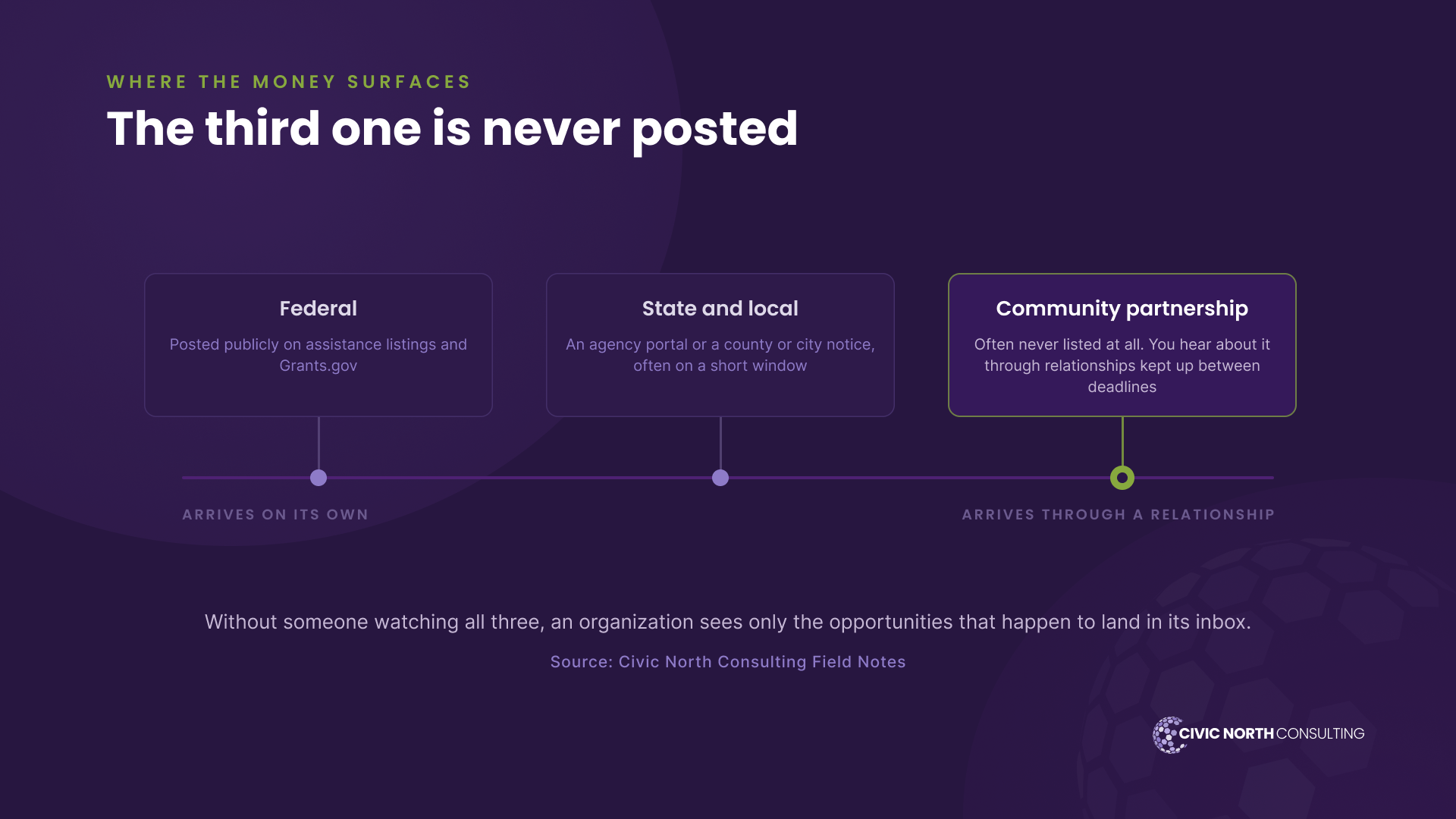
Reactive grant seeking misses opportunities at every level. Federal programs post through SAM.gov assistance listings and Grants.gov, and a lapsed SAM.gov registration blocks a federal application outright. State and local programs follow their own calendars. They often use a state agency portal or a county or city notice. Many also have short application windows. Community partnership opportunities, like a regional foundation’s pooled fund, may never be publicly listed. You often learn about them through relationships you maintain between deadlines. Joint applications with a school district or health system can work the same way. Without someone watching all three, an organization only sees the opportunities that happen to land in its inbox.
What are the 5 benefits of the grant retainer model?
- Proactive monitoring replaces panic. A retainer means someone watches federal assistance listings, state and local funding calendars, and partnership opportunities year-round. It replaces scanning Grants.gov the week something is due.
- Compliance stays current all year. Active SAM.gov registration is required to apply for or receive federal funding (SAM.gov). State portals and private funders keep their own registration and document requirements too. A retainer keeps all of them current, so a blocker doesn’t surface days before submission.
- Institutional memory compounds. Your consultant carries forward your outcomes data, your boilerplate, and your funder history. Each application gets faster and sharper than the last.
- Narrative infrastructure gets built once and reused. A foundational capture and preparation phase, built once, serves every subsequent deadline.
- Hiring stress disappears. You stop running a hiring cycle every time a deadline surfaces.
How do you build a sustainable grant pipeline?
The capture and preparation phase
This is the foundational work. You compile your evidence library, compliance documents, and outcomes narrative once. Then it’s ready to adapt rather than rebuild.
Long-term monitoring of assistance listings
Monitoring is a standing practice across federal, state, local and partnership sources, and it catches programs before they open.
Key takeaways on pipeline management:
- Nonprofit grant readiness is a continuous state that doesn’t wait for a deadline.
- Rural nonprofit funding moves on federal, state and local timelines you can’t see without regular monitoring.
- A grant consultant on retainer can cost less over a year than repeated one-off hires.
- Strategic alignment with funders raises win probability more than volume of applications.
What should you do next?
- Check your SAM.gov registration and your state grant portal accounts today.
- Pull your last three grant narratives. Note how much got rewritten from scratch each time.
- Compare the all-in cost of your last two reactive hires against a flat retainer rate.
A retainer model shifts the evaluator’s first impression. They see a complete, compliant, and well-aligned application. This is better than one assembled under deadline stress. Read more about how this retainer approach reduces reactive grant-seeking costs.
Learn why proposal burnout is an infrastructure problem, not an attitude problem.
Check your SAM.gov registration and state portal accounts this week. A lapsed registration blocks every application behind it. One thing worth stating plainly: our fees are never contingent on a grant award. You are paying for the work and the discipline, not a percentage of somebody else’s decision.
If you want to talk through which model fits your team, our calendar is open. Thirty minutes, and we will tell you if you don’t need a retainer.