We recently spoke with a vendor whose awarded contract vehicle had become, functionally, a paperweight. Eligibility was in place, the contract language signed, and a target market identified… the pipeline remained silent. They had treated the award as a finish line. But all it actually was, is a permission slip to start hunting.
The 2026 growth cycle rewards active vehicle management. Vendors who started that work in early 2025 are ahead, and anyone entering now can still diagnose the gaps. They should look at capture, compliance, and portal execution before the next solicitation or task order appears.
Why does the 2026 cycle require public sector strategy consulting?
Cooperative procurement bodies shift their attention over time, and which vehicles get that attention changes with them. The key point for a vendor is that tracking engagement is ongoing work, not just a post-award formality. A strong GovTech procurement strategy matches the vehicle to eligible states and likely buyers. It also names the internal owner for each next step.
Technical specs are the entry ticket. Positioning proof of past success sets your offer apart. This work must happen before a solicitation is posted.
Why wait-and-see pipeline management fails
An awarded vehicle does not create demand.
Amartya Sen built a Nobel-winning framework on this exact distinction. He separated what a person or an organisation is genuinely able to do from what it actually does, defining the first as:
“…the freedom to achieve valuable human functionings.”
Amartya Sen, 1990
In his terms a capability is the freedom to achieve, and a functioning is the achievement. The two are related, but the first does not cause the second. Sen argued that measuring capability, while assuming functioning, gives a confident but wrong picture.
An awarded contract vehicle is a capability. Revenue through it is a functioning. The permission slip framing is exactly right. The award changes what you are allowed to do. It does not change what you have already done. Everything below exists to convert the one into the other. You still need a territory plan and a marketing plan. You also need agency contacts. You need contract-compliant quotes and client-facing proposals. You also need tools to report on these activities and actual sales. Maintaining award records is not the same as deciding which agencies to pursue. It takes about the same amount of time.
Failure at this stage often stems from a systemic lack of proposal infrastructure that sabotages awarded contracts. A disciplined operating rhythm fixes this. Review vehicle activity. Update your positioning. Link each contract to a clear ICP. Then solve that ICP’s specific public-sector problem.
Capture discipline has a resourcing side too. Chasing more business than you can staff can turn a won vehicle into a margin problem. This is why forecasting headcount against pipeline belongs in the same review.
What activating a vehicle actually involves
Activation is unglamorous and mostly administrative, which is why it loses out to work that feels more like selling.
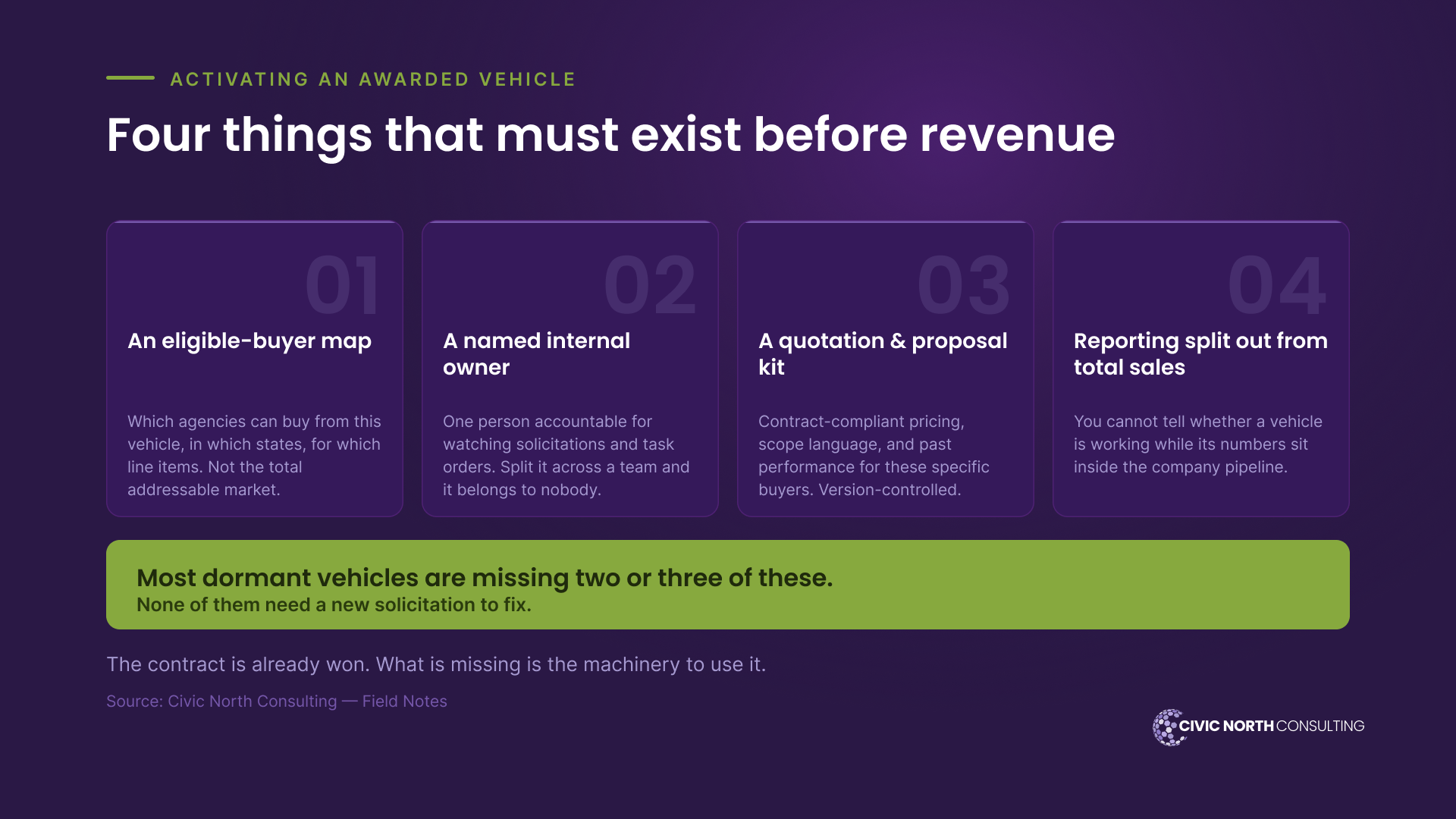
Four things have to exist before an awarded vehicle produces revenue.
- An eligible-buyer map. Which agencies can actually buy from this vehicle, in which states, for which line items. Not the total addressable market. The list of buyers whose procurement authority and your contract scope already agree.
- A named internal owner. One person accountable for watching solicitations and task orders against the vehicle. Split that duty across a sales team and it belongs to nobody.
- A quotation and proposal kit built to the vehicle’s scope. Contract-compliant pricing, the scope language, past performance relevant to these specific buyers. Version-controlled, because a documentation slip can cost an award outright, as one spreadsheet very nearly proved.
- Reporting that separates vehicle activity from total sales. You cannot tell whether a vehicle is working while its numbers sit inside the company pipeline.
Most dormant vehicles are missing two or three of these. None of them need a new solicitation to fix, which is the whole point. The contract is already won. What is missing is the machinery to use it.
Where to start
Run a diagnostic on your awarded vehicles to see if the constraint is market fit or capture discipline. Take that diagnostic before the next solicitation makes the decision for you. Watch delivery as you go. Profitability read after the project ends comes too late to change anything.

If your awarded vehicles are quiet and you want a second read on why, our calendar is open.